Coaching business
Group Coaching vs 1:1 Coaching: Which Coaching Business Model Is Right for You?
Choosing between group coaching and one-on-one coaching is one of the most important decisions for your business. Compare scalability, revenue potential, and client experience, and learn how a hybrid coaching business model could give you the best of both.
Contents
Group coaching vs 1:1 coaching - if you’re a new or early-stage coach, this is one of the first and biggest decisions you’ll face.
And it often brings up two honest questions:
“Which one is right for where I am right now?”
“And which one will actually help me grow without burning out?”
I talk to coaches every day, from people offering their very first sessions to those shifting from 1:1 into group programs, and here’s what I’ve learned: Both formats work beautifully. But choosing the wrong model for your stage can slow your growth and make your coaching business feel heavier than it needs to be.
This guide breaks down:
the real difference between group and 1:1 coaching
benefits and drawbacks of each
how your income, time, and energy shift with each model
a simple framework to choose the right format
why hybrid coaching is becoming the norm in 2025
and how to transition from 1:1 → group coaching smoothly
If you haven’t already explored the foundation of this topic, I strongly recommend reading: The Complete Guide to Starting an Online Coaching Business (2025 Edition)
It sets the right mindset for building a coaching business with clarity, structure, and community, the worldview that makes everything in this guide even more powerful.
Now let’s break it down.
TL;DR
1:1 coaching is best when you're early, validating your process, or want deep transformation.
Group coaching helps you scale, more revenue per hour, more leverage, more accountability, and stronger community outcomes.
New coaches usually start with 1:1.
Growing coaches shift to group once their method is proven.
Ambitious and established coaches combine both using a hybrid model:
Premium 1:1 → Scalable group program → Community/Course ecosystem.If you feel stretched or want to serve more people without more hours, group coaching is likely your next move.
2025 coaching trends lean heavily toward community-led group programs because peer support improves results dramatically.
This blog dives deep into each point, so you can make the right decision for your coaching business.
The Real Difference Between 1:1 and Group Coaching
When you look up “1:1 vs group coaching” online, the definitions you find often feel outdated or overly academic. But coaching has changed. The way clients learn has changed. And the coaching program models coaches use today look very different from what they did even a few years ago.
So before we compare benefits or talk about scaling, I want to set a clear, modern foundation for both formats, the way coaches actually use them in 2025.
What 1:1 Coaching Actually Means (Modern Definition)
Most people think of 1:1 coaching as “private sessions with a client,” but that’s the old definition.
Today, 1:1 coaching is a deeply personalized experience. It’s you working closely with a client, understanding their patterns, adjusting the plan in real time, helping them break through emotional blocks, and guiding them with complete attention. It’s flexible, intimate, and built entirely around one person’s pace and needs.
But here’s the truth most new coaches don’t realize: 1:1 coaching is where your real coaching method is born.
It’s where you refine your frameworks, learn what actually works, identify client patterns, understand the results you can promise, and build the confidence that later allows you to coach groups with ease. Almost every effective group coaching model that exists today was first shaped inside dozens of 1:1 conversations.
So while 1:1 coaching can feel time-consuming, it’s also the fastest way to become an excellent coach and the most direct way to validate your process.
What Group Coaching Actually Means (2025 Version)
Group coaching has evolved even more. It’s no longer “a few people on a Zoom call.” The modern group coaching model is structured, intentional, and designed for scale.
In 2025, a group program typically blends live sessions, a clear curriculum, a supportive community, peer accountability, guided resources, and small action steps that keep clients moving forward together. Instead of clients relying only on your guidance, they learn from one another, celebrate wins together, and stay motivated because they’re surrounded by people on the same journey.
The biggest shift?
Group coaching is now a pathway, not an event or a series of sessions.
People don’t just join for information, they join for structure, consistency, belonging, and shared progress. And because the delivery is repeatable, you can run the same program multiple times a year without recreating everything from scratch.
The result is a coaching format that multiplies your impact while reducing your hours, which is exactly why group coaching has become the top choice for coaches who want sustainable growth.
1:1 Coaching - Benefits, Drawbacks & Best Use Cases

1:1 coaching is where most coaches begin, and there’s a good reason for that. It’s the most direct, intimate, and customizable way to help someone create change. But it also comes with limitations that become very real once your client list starts growing.
Let’s break it down with full honesty.
Benefits of 1:1 Coaching (Depth, Personalization, Trust)
The biggest advantage and one of the core one-on-one coaching benefits is depth. When you’re working with a single client, you’re able to listen more closely, personalize every step, adjust in real time, and build a relationship where the client feels genuinely seen and supported.
This level of intimacy creates transformation quickly, especially for clients who need emotional safety or hands-on guidance.
In the early months of your coaching business, this depth also becomes your secret advantage. You learn your clients’ language, you understand their patterns, and you refine your method far faster than any course or group program could allow. Every session teaches you something valuable about how to help the next person better.
1:1 is the fastest accelerator for your own coaching mastery.
Where 1:1 Coaching Holds You Back (Time, Burnout, Inconsistency)
But the same strengths of 1:1 coaching eventually hit limits.
There are only so many hours you can give in a week. Only so many clients you can fully support. And only so much emotional energy you can pour into one person at a time.
Most coaches hit the point where their calendar fills up, but their income doesn’t. More sessions start to feel like more exhaustion, not more growth.
This is where burnout typically creeps in:
Your week becomes unpredictable
Your revenue becomes inconsistent
You feel “stuck” at a certain monthly income
You’re constantly context-switching between clients and tools
You can’t take a break without losing money
When every result depends entirely on your presence, scaling becomes almost impossible.
When 1:1 Is the Right Choice (Especially for New Coaches)
Even with its limits, 1:1 coaching is still the best starting point for most early coaches, not because it’s easier, but because it’s the most reliable way to validate your process.
If you’re in any of the following stages, 1:1 is the right call:
You’re refining your method and don’t want to commit to a fixed curriculum yet
You’re still learning who your ideal client truly is
You want to build confidence and understand client patterns
You’re developing your signature framework
You don’t yet have an established audience for group coaching
You want testimonials and case studies before you scale
Think of 1:1 as your R&D department. Your group program will eventually be built on what you learn here.
1:1 Coaching Revenue Example (Simple Math for 2025)
To understand its limits, let’s run quick, realistic math. Let’s say you charge ₹4,000 per session (or $150 in global terms) as a new coach. If you coach 20 clients a month, doing one session each, that’s:
20 clients × ₹4,000 = ₹80,000/month (or $3,000/month)
To grow beyond that, you need to:
Increase your price
Add more sessions
Find more clients
But each option pulls more time and emotional load from you.
Even if you raise your rate to ₹8,000 ($300) per session, serving 20 clients still caps you at:
₹1,60,000/month (or $6,000/month)
You’re earning more, yes, but you’re still trading time for money, and burnout remains the biggest risk. This is exactly why coaches eventually shift to group programs: more income, more transformation, fewer hours.
Group Coaching - Advantages, Risks & Use Cases
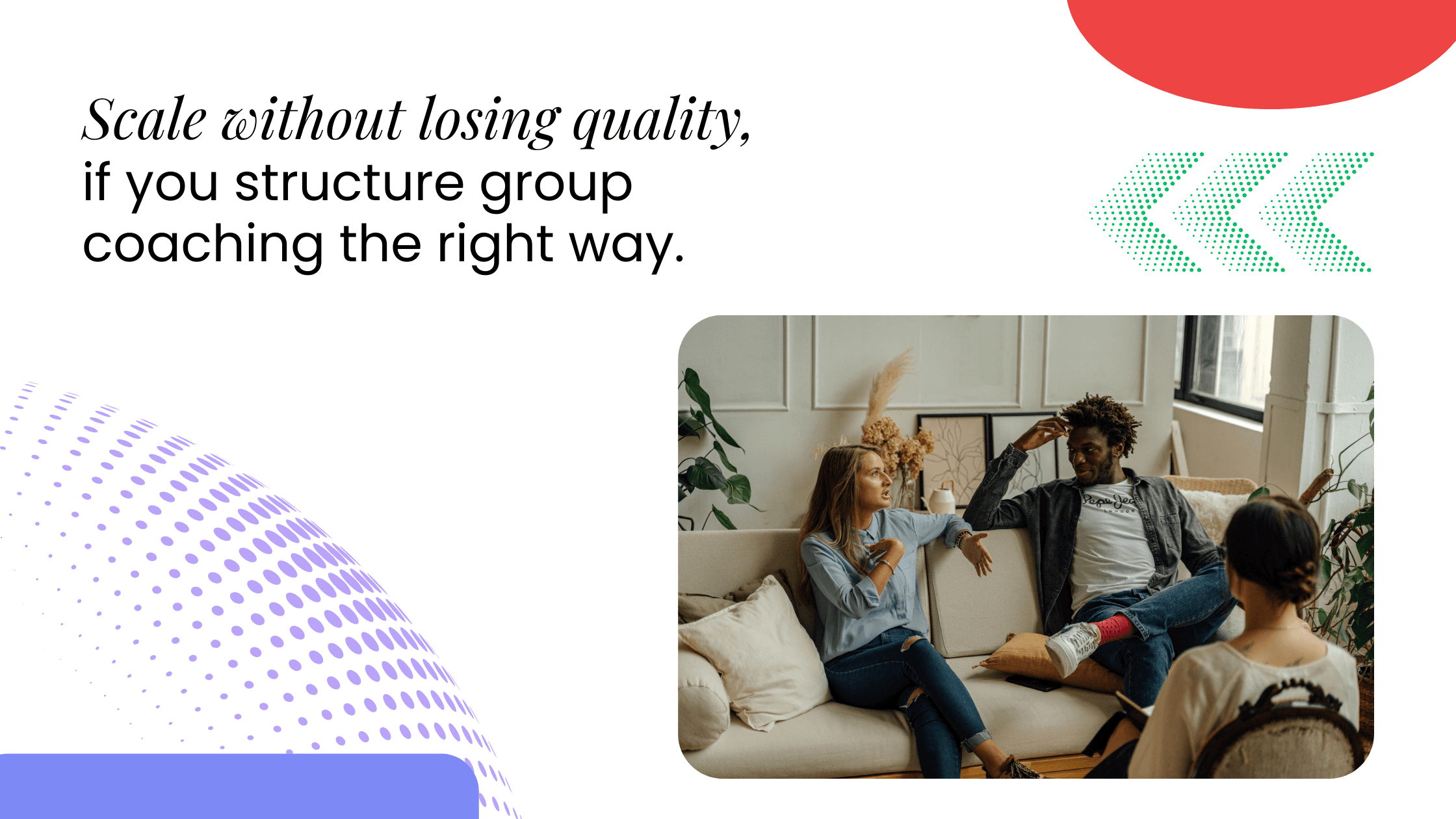
If 1:1 coaching is about depth, group coaching is about momentum. Clients move faster when they see others moving with them. And as a coach, this shift gives you more leverage, more time, and more predictable income.
But just like 1:1 work, group coaching has its own strengths and challenges, and it works best at specific stages of your business. Let’s unpack it in a real, practical way.
Benefits of Group Coaching (Collaboration, Scale, Leverage)
The biggest reason group coaching has benefited so many clients in the last few years is simple: people learn better together.
When clients are surrounded by others with similar goals, two things happen:
1. Accountability increases dramatically.
Clients show up more consistently because they don’t want to fall behind the group.
2. They learn from perspectives you could never provide alone.
Someone asks a question others were afraid to ask. Someone shares a breakthrough that triggers five more. Someone struggles and the group rallies to help.
Group coaching doesn’t dilute results. It multiplies them.
On the coach’s side, the benefits are just as big as the following. You get to do:
Deliver once, help many
Create a repeatable curriculum
Feel less emotionally drained
Build a supportive client community
Unlock scalable growth without losing quality
Your income stops depending on the calendar
Most importantly, your time becomes leveraged, not stretched.
You’re no longer trading hours for money; you’re building a system that can serve multiple people every time you show up.
Disadvantages of Group Coaching (Fit, Structure, Prep Time)
Group coaching is powerful, but it’s not a magic shortcut.
Here are the parts coaches often underestimate:
1. A clear, repeatable method
If your process changes from client to client, group sessions can feel scattered. It also means tons of work for you.
2. Structure and sticking to it
Group coaching thrives on rhythm, not spontaneity. Weekly calls, milestones, check-ins, challenges, these create the momentum.
3. Manage group dynamics
Some clients talk too much. Some stay quiet. Some need more support. You have to hold the room and balance the energy.
4. Spend more upfront time preparing
Once built, a group coaching program runs smoothly. But the first time? It takes real focus and lots of work to create a curriculum, worksheets, tasks, and a flow that works for everyone.
These aren’t deal-breakers, but they are important to know before you jump in.
When Group Coaching Is Not a Good Idea (Important Insight)
This is rarely said, but it’s true: Group coaching is NOT ideal if you don’t yet have a proven process.
If you’re still figuring out your framework, steps, and outcomes, a group setting can feel overwhelming. Clients will have mixed needs, mixed starting points, and mixed expectations.
Group coaching also isn’t a great fit when your:
Audience size is still tiny
Niche requires heavy emotional support
Transformations are extremely personalized
You haven’t coached enough people 1:1 to see patterns
You can’t confidently teach your process to multiple people
There’s nothing wrong with this. It simply means you’re in the clarity-building stage, not the scaling stage.
Group Coaching Revenue Example (Cohort & Monthly Model Math)
Here’s where group coaching becomes a complete game-changer.
Let’s take a realistic example:
Scenario 1 - Cohort Model (8 weeks)
You charge ₹3,000 per person (or $100 globally). You enroll 50 members.
50 × ₹3,000 = ₹1,50,000 per cohort (or $2,000 per cohort) with less work.
And you deliver just one program for everyone.
If you run this program 6 times a year, that’s:
₹9,00,000/year (or $12,000/year) from ONE group program alone.
Notice the difference? You earn more by helping 20 people for 8 weeks, than helping 20 people 1:1 every single month.
Scenario 2 - Monthly Group Program (Subscription Model)
You charge ₹3,000/month (or ~$35). You enroll 50 members
That’s: ₹1,50,000/month (or ~$1,750/month)
Think about increasing the cost or number of clients per cohort. The numbers will shoot up like crazy.
And it scales every month without increasing your hours.
Now imagine layering in:
Community access
Challenges
Q&A sessions
Self-paced content
Guest expert calls
Weekly accountability threads
This is how modern group coaching programs become sustainable ecosystems, not just one-off cohorts.
Group Coaching vs 1:1 Coaching - Comparison Table
If you’re trying to decide which coaching model fits your goals, seeing group coaching vs 1:1 coaching side-by-side makes the decision much clearer. Both formats work, but they serve very different seasons of your coaching business.
Here’s the updated 2025 comparison:
Factor | 1:1 Coaching | Group Coaching |
Time investment | High - your schedule fills fast | Low to Moderate - one session serves many. But the initial work to set up the complete workflow will be extremely high. |
Scalability | Low - capped by your hours | High - repeatable delivery, unlimited growth |
Stress | High - emotional load is heavier | Low - shared energy and structure |
Client experience | Personalized, intimate | Collaborative, motivating, community-driven |
Revenue potential | Moderate to high (for high-ticket coaching) - tied to time | Very high - leverage multiplies income |
Best for | New coaches building clarity | Growth-stage coaches scaling impact |
If you want depth and learning → start with 1:1.
If you want scale → move into group coaching.
And if you want a coaching business that grows without burning you out and offers the best of both worlds, the hybrid model is the best choice for you. We’ll discuss more on it below.
5 Questions To Choose the Right Coaching Model
If you’ve made it this far and still feel torn between group coaching and 1:1 coaching, don’t worry, it’s normal. Choosing your coaching model isn’t about trends or what everyone else seems to be doing. It’s about choosing the model that matches your season, your capacity, and your business goals.
This simple 5-question framework will help you answer the big question: “Which is better for me, group coaching or 1:1 coaching?”
Let’s walk through it.
Q1 - How many clients do you want to serve per month?
This is the simplest way to see where you fit. If you want to take on a small number of clients, offer deep transformation, and work closely with each person, then 1:1 coaching naturally fits that desire. You’ll have fewer clients, more intimacy, and more flexibility.
But if your goal is to help dozens (or hundreds) of people without working dozens of hours, then group coaching is the only model that makes that possible. A single session can support many, which puts your time back in your hands.
If you’re still working on consistently attracting those clients, read How to Get Coaching Clients Online (Practical Framework) to build a steady flow of the right clients first.
Rule of thumb:
Few clients → 1:1 works beautifully
Many clients → Group coaching wins every time
Q2 - How much time do you want to spend weekly?
Ask yourself honestly: “How many hours do I actually want to coach in a week?”
Most coaches think they can handle 20-30 sessions a week, until they try it.
1:1 coaching takes emotional presence. It requires energy. It’s a lot of context switching. Whereas group coaching concentrates your delivery:
One live call
One Q&A session
One set of weekly tasks
One curriculum
And you're done. If you want more space, more balance, and more predictability, group coaching aligns much better. If you enjoy deep, focused, one-on-one work, then 1:1 remains a beautiful choice.
Q3 - Do you prefer depth or collaboration?
This is one of the most underrated questions.
If you love diving deep with one person, their history, their patterns, their mindset, and their story, then 1:1 coaching is where you thrive. Depth requires intimacy.
But if you get energized by group momentum, shared wins, shared struggles, group conversations, collaboration, and challenges, then group coaching is your natural stage.
Neither is “better.” They’re just different types of fulfillment.
Q4 - Do you already have a proven method?
This is the biggest deciding factor for coaches wondering if they should offer group coaching or 1:1 coaching first.
If your process is still evolving, you're still experimenting, adjusting steps, changing your delivery, group coaching will feel too rigid too soon.
Group programs thrive on structure and repeatability. So if you haven’t yet validated your method through at least a handful of 1:1 clients, take your time.
But if your method is clear, repeatable, and you can teach it to multiple people at once, you’re ready to scale into a group program.
Q5 - What’s your income goal for the next 6 months?
This is where the decision becomes practical.
If your income goal is modest and you’re not in a hurry to scale, 1:1 coaching alone can easily help you meet that goal, especially if your offer is premium.
But if you want:
Higher monthly income
Predictable growth
Recurring revenue
Less time spent working
Better long-term scalability
Then group coaching is the smarter model.
Group coaching multiplies your earnings because you're not exchanging time for money anymore; you're exchanging systems for cash.
Hybrid Coaching Model (Most Scalable Model in 2025)

Most coaches begin with a simple question. Should I choose 1:1 or group coaching? But the truth is, the most successful coaching businesses in 2025 don’t choose. They blend both.
The hybrid coaching model is the sweet spot between depth and scalability. It gives you the personalization of 1:1, the momentum of group coaching, the structure of a curriculum, and the long-term retention that comes from community and digital products.
It’s not just a coaching format. It’s a business model, one that grows with you instead of overwhelming you.
Let’s break down how it works.
Start With 1:1 (Your Method’s Foundation)
Every strong hybrid model begins the same way: with a handful of 1:1 clients.
This phase is where you:
Refine your ideas
Notice patterns in client journeys
Clarify the “steps” in the transformation
Understand where people get stuck
Learn what support they actually need
This becomes the raw material for your repeatable curriculum later.
1:1 is not the end, it’s the research stage for everything you build next.
Add Group Coaching (Your Scalable Delivery System)
Once your method is clear enough to teach, the next layer is a group program. This is where you take what worked in 1:1 and turn it into:
A structured pathway
Weekly or biweekly calls
Shared milestones
Q&A sessions
Implementation weeks
You’re no longer reinventing your coaching process every session. You’re guiding multiple people through the same pathway, consistently, predictably, and with far less effort. This is your group coaching model, the core of the hybrid structure.
Layer in Community (Your Retention Engine)
A curriculum is what gets people results. But community is what keeps them engaged long enough to get those results.
Modern coaching has shifted away from pure “information delivery” and toward:
Peer accountability
Shared progress updates
Themed discussions
Member challenges
Support threads
Check-ins between calls
A strong community lets clients feel connected even when you're not live with them. It also reduces support pressure as clients help each other.
And this part fits perfectly with Wylo’s strengths: hosting discussions, threads, events, courses, memberships, resources, and accountability inside a branded coaching hub.
Offer Digital Products & Quick Courses (Your Passive Layer)
Once your core coaching method is structured, parts of it can naturally become:
Mini-courses
Templates
Checklists
Toolkits
Short workshops
Pre-recorded lessons
These serve two purposes:
They warm up cold leads by giving them a low-ticket entry point.
They support your existing clients with self-paced learning.
Your knowledge stops being “locked inside sessions”; it becomes an ecosystem of helpful assets. And all of it increases your earning potential without increasing your hours.
If you’re ready to turn your method into a course alongside your coaching, this step-by-step guide on How to Create & Sell Your First Online Course will walk you through it.
Add a Monthly Membership (Your Recurring Revenue Layer)
A monthly membership is the final piece of the hybrid model.
It creates:
Predictable income
Long-term retention
Deeper relationships
Ongoing accountability
A space clients don’t want to leave
Instead of constantly chasing new clients, the hybrid model lets you build a base of people who stay with you for months or even years.
Memberships are where your coaching business stabilizes and where your community truly becomes your strongest asset.
Automate Accountability (Your Time-Saving Layer)
In 2025, the hybrid model also leans heavily on automation, not to replace coaching, but to support it.
Think:
Weekly check-in prompts
Habit tracking
Quick reminders
Pre-scheduled tasks
Onboarding flows
Progress milestones
These tiny automations multiply your client's consistency, while freeing your time and reducing emotional load. It’s the difference between pushing clients and guiding clients inside a system that supports them automatically.
Why the Hybrid Model Wins
Here’s the simplest way to see it:
1:1 builds mastery.
Group coaching builds scale.
Community builds retention.
Digital products build leverage.
Memberships build stability.
Automation builds freedom.
The hybrid model stitches all of this together into a coaching business that grows with you, sustainably, profitably, and without burnout. This is the model top coaches are shifting to in 2025 and platforms like Wylo are designed to support end-to-end.
How to Transition From 1:1 Coaching to Group Coaching
Shifting from 1:1 coaching to group coaching is one of the biggest growth milestones in a coach’s career. But it’s not something you want to rush. There’s a right way to do it; one that feels natural, confident, and smooth, both for you and for your clients.
Here’s the exact transition path most successful coaches follow in 2025.
Step 1 - Validate Your Process Using 1:1 Clients
Every group coaching program begins with clarity, and clarity comes from real client experience.
Before you ever think about launching a group program, use your 1:1 clients to:
Test your frameworks
Notice repeatable steps
Understand where clients get stuck
Identify the common questions people ask
Refine your unique approach
Clarify what outcomes you can reliably promise
Think of your 1:1 clients as your research team. They show you which parts of your process are solid and which parts need improvement.
When you start noticing patterns, “Clients always get stuck at a specific step” or “Everyone needs the same foundations”, you know you're ready for the next stage.
Step 2 - Build a Repeatable Curriculum
A group program is not a collection of sessions. It’s a pathway, a sequence of steps clients follow together.
This is where you turn all the insights from 1:1 coaching into a structured, repeatable curriculum.
A good curriculum includes:
Weekly modules or themes
Clear milestones
Specific goals for each stage
Tasks or assignments
Frameworks, templates, and worksheets
A clear “start → finish” transformation
Don’t overcomplicate it. Your first version doesn’t need 20 modules; it just needs to be clear, simple, and aligned with your core method. Once you can articulate, “Most clients move through these 5-7 steps,” your group program has its skeleton.
Step 3 - Pre-Sell Your First Cohort (Realistic Numbers)
One of the biggest myths is that you need a huge audience to run a group program. You don’t.
Your first cohort can be: 5 people, 8 people, or even 3 people
What matters is starting.
Pre-selling means you announce the idea before creating everything perfectly. You share: the promise, the path, the start date, the number of spots, the outcome, the price.
And you validate interest.
This gives you: confidence, commitment, cash flow, clarity on how many people want this, and real humans shaping your first version.
Even earning ₹40,000-₹80,000 from a small cohort is a great start and far lighter than running 20+ 1:1 sessions a month.
Step 4 - Add Community for Support & Accountability
Most group coaching programs fail not because of bad content, but because clients lose momentum between sessions. This is why community is the backbone of modern group coaching.
A strong community gives clients:
A place to ask questions
Daily accountability
A motivating group of peers
Encouragement when they hit challenges
A sense of belonging
Sharing wins and progress updates
The community becomes the space where they grow together and where you no longer have to handle every question 1:1.
Step 5 - Automate the Delivery Over Time
Once your first cohort runs successfully, your goal isn’t to “work more.” It’s to work less while clients get better results. This is where automation comes in.
You can automate:
Onboarding sequences
Weekly reminders
Task prompts
Habit tracking
Check-in messages
Lesson releases
Accountability threads
Automation doesn’t replace your coaching; it supports it. It keeps clients consistent and reduces the emotional load on you. Over time, your group coaching program becomes a smooth, predictable, scalable system. You simply show up to deliver what only you can deliver, the rest runs on rails.
The Transition Summary
Transitioning from 1:1 coaching to group coaching is not a leap, it’s a progression.
Validate → Structure → Pre-sell → Build community → Automate
And once you follow these steps, you end up with a program that serves more people, delivers stronger results, and gives you your time and freedom back.
Common Mistakes Coaches Make With Coaching Models
Even though 1:1 and group coaching serve different purposes, coaches often hit the same roadblocks, usually because of how they structure (or don’t structure) their coaching program models. These mistakes slow growth, reduce client results, and make both 1:1 and group coaching harder than they need to be.
Here are the most common ones to avoid.
Trying to Run Group Coaching Too Early
A group program needs clarity, structure, and a repeatable process. When coaches jump into group coaching without first validating their method through 1:1 clients, the program feels scattered, clients move at different speeds, and the delivery becomes exhausting. Group coaching works best when the foundation is proven.
Staying Stuck in 1:1 Too Long
On the flip side, some coaches stay in 1:1 far longer than necessary. They keep reinventing their delivery for every client, hit income ceilings, and eventually burn out, even though the patterns in their work are clear enough to scale or move up market (high ticket coaching).
If your clients keep asking the same questions, facing the same blocks, and walking through the same steps, that’s a sign your group program is ready.
Not Creating a Strong Onboarding Experience
Whether it’s 1:1 or group coaching, onboarding sets the tone. When it’s weak or unclear, clients:
don’t know what to expect
show up inconsistently
lose confidence early
A clear onboarding flow, goals, expectations, first steps, success benchmarks boosts results before the first session even starts.
Skipping a Community Support System
One of the biggest group coaching disadvantages is when coaches try to deliver transformation without a space for clients to connect between sessions.
Without community:
accountability drops
clients feel isolated
questions pile up
momentum fades
A community hub solves this instantly and it reduces your support load dramatically.
Pricing Too Low
This happens in both models. Underpricing creates:
low commitment
high dropout rates
overwhelmed coaches
undervalued results
Pricing should reflect the transformation, not your self-doubt.
If pricing is the part that makes you hesitate, our guide How to Price Your Coaching Programs Confidently gives you a clear, value-based way to set your rates.
Not Building Repeatability
The biggest hidden mistake: treating every client like a brand-new project.
Repeatability is what turns coaching into a real business. It’s what allows:
consistent client results
smoother delivery
scalable programs
better energy management
If you want to grow, build frameworks, don’t rely on improvisation.
So Which Coaching Model Is Best in 2025?
If you’re looking for the simplest answer:
1:1 coaching is best when you’re building clarity.
Group coaching is best when you’re ready to scale.
New coaches get the fastest growth and the deepest learning through 1:1 work, it’s where you develop your method, find your voice, and understand what truly creates results.
Once you start seeing patterns, once clients begin following similar steps, and once you’re ready for predictable income (without trading every hour), group coaching becomes the natural next step.
And if long-term stability and freedom are your goals, the hybrid model - 1:1 → group → community → membership, is the structure almost every successful coach eventually adopts.
The “best” model isn’t universal. It’s the one that matches your stage, your energy, and your goals.
FAQ: Group Coaching vs 1:1 Coaching
Q1: Is group coaching more profitable than 1:1?
Yes, once your method is validated, group coaching becomes significantly more profitable. Instead of trading hours for income, you deliver once and help many. Even a small group of 8-15 members can exceed the monthly revenue of 20+ 1:1 clients, with far less time and emotional load.
Q2: How many people should be in a group coaching program?
For your first cohort, 5-12 people is ideal. It’s small enough to manage easily, but large enough for collaboration and accountability to naturally form. As you refine your curriculum and systems, you can scale to 20, 30, or even 100+ depending on your niche and support structure.
Q3: Can you run 1:1 and group coaching together?
Absolutely. In fact, most successful coaches operate both simultaneously. Clients who want personalized depth choose 1:1, while others join the group program for structure and community. This hybrid approach gives you diversified income, predictable retention, and a scalable business.
Q4: When should a coach switch from 1:1 to group coaching?
You’re ready to switch when:
your 1:1 clients follow similar steps
you can articulate your method clearly
you see repeatable patterns in client challenges
your calendar feels full, but your income is capped
your emotional energy feels stretched
These are strong signs that your process is ready to be taught to multiple people at once.
Q5: Do clients get results with group coaching?
Yes, often faster than in 1:1. Group coaching adds accountability, peer learning, shared motivation, and collective momentum. Clients see others progressing, ask better questions, and feel part of a community moving toward the same outcome. This increases consistency dramatically, which is the #1 predictor of results.
Conclusion
Choosing between 1:1 coaching and group coaching doesn’t need to feel overwhelming. You just need clarity on where you are today and where you want to be six months from now.
If you’re still refining your process, start with 1:1. If you’re craving scale and structure, move into group. If you want stability, build a hybrid ecosystem that grows with you.
Whatever you choose, remember: coaching becomes easier, lighter, and far more impactful when you have the right systems behind you.
If you’re ready to build your coaching business the right way, with clarity, structure, community, and complete brand control.

About the Author - Omnath
Founder of Wylo, a highly comprehensive and customizable community platform for coaches, brands, and creators. Omnath helps coaches build structured, scalable, community-driven businesses through simple systems, clear frameworks, and high-quality client experiences.