Coaching business
How to Create and Sell an Online Course on Modern Learning Platforms
Ready to turn your knowledge into a profitable online course? Learn how to validate your idea, price it right, and sell it using modern online learning platforms, even if you're starting with a small audience.

Contents
Creating and selling your first online course is one of the most powerful ways to scale your coaching business. It allows you to help more people at once, turn your transformation into a repeatable system, and finally move beyond the limits of 1:1 time. But if you’re like most coaches, the idea of building a course can feel overwhelming at the start.
You might be asking yourself questions like: What should my course even cover? Will anyone buy it? How do I structure it so people actually finish it? Do I need fancy production or a huge audience?
These thoughts are completely normal and, more importantly, they’re solvable.
Here’s what has changed in 2025: People don’t want long, information-heavy courses that sit unfinished. They want simple, guided courses that lead to a real transformation, the exact transformation you already guide clients through every day.
The good news? You don’t need a large following, a complicated funnel, or months blocked out for filming. In fact, the most successful coaches today do the opposite:
They start small, build with their early students, and sell before creating everything.
This guide will show you a practical, step-by-step method to build and launch a course that your audience is genuinely excited to join without pressure, perfectionism, or burnout. You’ll learn how to validate your idea, structure your lessons, stay consistent, and create an experience people finish, love, and recommend to others.
If you’re still defining your niche or haven’t yet created your coaching offer, you might want to start with the full foundation here: How to Start an Online Coaching Business (2025 Edition)
Now, let’s begin with the most important step, choosing a transformation people are already searching for.
TL;DR
You don’t need a huge audience or complicated funnels to sell your first online course in 2025. Choose a clear transformation, validate interest with real people, pre-sell a simple version before creating it fully, and deliver with a structure that drives completion. Once your students get results, referrals and momentum follow naturally.
Step 1 - Pick a Transformation People Actually Want
If a coaching program helps someone feel supported, an online course helps someone make progress on their own. That means the transformation must be clearer, more self-guided, and more structured than a 1:1 offer.
This is where most new course-creators get stuck.
They pick a topic, not a transformation.
Topics sound like: “Mindset”, “Productivity”, “Nutrition”, “Career development”
Transformations sound like:
“Stop spiraling and make confident decisions in 3 weeks.”
“Build a sustainable 20-minute fitness routine from home.”
“Land more interviews in the next 30 days.”
“Make healthier meals even with a busy work schedule.”
The difference is everything. A topic informs. A transformation moves someone to take action they’ve been stuck avoiding. And online courses are bought for action, not information.
Your learners are silently asking: “What will be different about my life by the time I finish this?”
If they can’t see the after-picture clearly, they hesitate. They browse. They bookmark. They don’t buy.
But when they instantly understand:
Who the course is for
What struggle does it finally solve
What outcome will they walk away with
That’s when buying feels like relief instead of decision fatigue.
The 2025 Coaching Transformation Formula
Here’s a simple sentence you should write before you create a single lesson: “This course helps [specific person] go from [pain before] to [betterment after] in [a clear timeframe] through [your method].”
Examples across niches:
Vague Topic | Actual Course Transformation |
“Mindset course” | “Help anxious professionals replace self-doubt with confident action in 4 weeks.” |
“Fitness course” | “Help new moms rebuild core strength + energy in 30 days with simple home workouts.” |
“Career course” | “Help job seekers land more interviews in 21 days with a repeatable application system.” |
Clarity like this does three important jobs:
It filters the right buyers in
It builds trust instantly
It becomes the foundation of your marketing & lesson structure seamlessly
This is where the best-selling courses win before they even launch.
But What If You Don’t Know Your Transformation Yet?
You absolutely do, it’s the same transformation: you’ve lived, you’ve helped others achieve, and you wish you had guidance on
Your course is a roadmap you’ve already walked, just designed so others don’t have to struggle as long as you did.
If your 1:1 niche is already clear → your course is simply the “scaled” version of that same promise.
If you’re still shaping your niche → the transformation exercise above gives you the clarity your business has been missing.
Pro tips:
When you define transformation clearly, you create momentum before the course even exists. Clarity attracts. Structure delivers. Community sustains.
Step 2 - Validate Coaching Demand Before You Build

The harsh truth about online courses isn’t that creating them is hard, it’s that too many coaches spend weeks recording videos no one ends up watching. Not because the course isn’t valuable, but because the offer wasn’t tested.
Validation ensures:
People actually want the transformation
They want you to deliver it
They’ll pay to solve the problem now, not “someday”
This is where your coaching course becomes a real business, not a hopeful project. And the fastest way to validate anything online, especially in 2025, is conversation over content.
What Client Validation Feels Like
You know your course is validated when:
People reply quickly to messages about it
They ask “When is it coming?” before it exists
You can enroll your first students before recording a single lesson
If you launch and hear crickets? That’s a validation issue, not a marketing issue.
Your Coaching Validation Goal
Get 3-10 people to commit (or pre-commit) to the course before you build it.
This does three things:
- Proves the idea has real demand
- Gives you immediate feedback while building
- Motivates you, because you’re doing this with them
Most profitable courses started small before scaling big.
The 2 Signals You’re Looking For
1) Emotional Pain Signal
People say things like:
“This is exactly my problem.”
“I’ve tried everything.”
“If I could fix this, everything would change.”
This means the transformation matters.
2) Urgency Signal
They’re not just interested, they’re annoyed they haven’t solved this yet:
“I need this now.”
“This is so timely.”
“I really need help with this.”
If you have both → you’re selling a solution to a real problem.
If you have only 1 → the offer needs refinement.
The 2025 Validation Method
We do not validate with surveys. We validate with engaged human responses.
Here’s the simple rhythm: Post → Engage → DM → Clarify
Choose 1 platform where your audience already follows you (Instagram or LinkedIn is great for this stage).
Post content that speaks directly to:
The before-state frustrations
The desired after-state outcomes
As conversations happen, ask: “If I created a short guided program that helped you achieve ___ in ___ weeks, would that help?”
If a handful say “YES”, even a soft yes, you’re ready.
What If Prospects Don’t Respond?
Two possible reasons:
The idea isn’t sharp enough. It is missing clarity in transformation (Step 1 fix)
Wrong audience - You’re talking to observers, not buyers
Neither means the topic is bad, just that the way it’s positioned and targeted needs tightening. Every tweak gets you closer to what people are silently waiting for.
If you want to learn a simple, human method to start conversations and enroll clients from your earliest audience, read this: How to Get Coaching Clients Online (Practical 2025 Framework)
Step 3 - Design a Course That Gets Completed
Most online courses don’t fail because they lack great information. They fail because the student loses momentum somewhere in the middle. People don’t always drop out because they’re lazy or uncommitted; they mostly drop out because:
They feel overwhelmed by too much content
There’s no sense of progress
They’re not sure they’re doing it right
Life interrupts and there’s no support holding them
To build a course that people finish, you must design for psychology, not perfection. The goal isn’t to create everything you know. The goal is to help a beginner get their first real win as quickly as possible. That win creates belief. Belief creates momentum. Momentum carries them to the finish line.
People Don’t Buy Curriculum. They Buy Confidence
When someone enrolls in your course, they’re silently telling you: “I want to believe I can finally do this.”
Your course must reward that belief immediately. That’s why every strong course starts with the same building block:
Module 1 = Quick Win
Something small, doable, visible, that proves:
“This is working”
“I can do this”
“I’m not stuck anymore”
Once that happens, learners don’t want to quit, because the identity shift has already started.
The Completion-Friendly Course Structure
Great courses have three core design elements:
Short Lessons (5-10 minutes max)
Modern learners don’t stick with 45-minute videos. Short lessons feel easy to start and then easy to continue.One Action Per Lesson
Every lesson should end with: a decision, a reflection, or a micro-behavior. When progress becomes habitual, completion becomes automatic.Built-In Accountability & Feedback Loops
This is where most coaching businesses fail students. People need someone or a group, watching with care.
Even a simple weekly reflection makes a difference:
“What changed for you this week?”
“What felt easier?”
“What did you learn about yourself?”
Small accountability → large transformation.
Your Course Structure Formula
This is the exact layout proven to maximize completion rates:
6-8 weeks
6-8 core modules
3-5 short lessons per module
One action per lesson
Weekly support touchpoints
Lean. Human. Achievable.
If you do this right, you’ll never be the coach with an impressive course library, but a disappointed completion rate. Instead, you’ll be the coach whose students finish and tell others.
Why Dripped Content Works
Releasing modules gradually accomplishes what binge-learning never can:
It prevents overwhelm
It increases anticipation
It creates space to implement
It gives you time to adjust based on early feedback
Progress becomes a rhythm, not a sprint, and rhythm is what makes people sustain.
A Community Changes Everything
Students who learn together: feel less alone, celebrate progress publicly, and commit to showing up again tomorrow.
That’s why completion rates skyrocket when there’s: a discussion area, a wins thread, or a weekly live circle
Every supportive interaction reinforces the identity: “I am someone making real change.”
It’s not marketing. It’s human behavior.
Pro tips:
The future of online learning is human-first:
Safe spaces
Guided action
Real accountability
A course becomes transformative only when someone learns, someone tries, someone notices, and someone cares.
Step 4 - Pre-Sell Your Course’s First 5-20 Seats

Most new creators think they must record every lesson, design every worksheet, and build a perfect course portal before they sell anything. But in 2025, it works the other way around:
The smartest course-creators sell first. Then they build with their students, not in isolation.
Preselling is not just a marketing strategy; it’s a validation milestone, a confidence booster, and a momentum machine. It ensures you’re not creating in the dark. You’re delivering what people have already confirmed they want.
When someone pays before the course exists, it proves:
They trust you
They believe the transformation is worth it
The problem is urgent enough to solve now
That’s the difference between a “course idea” and an actual coaching product.
Why Preselling Works Better Than Launching Fully Crafted Coaching Courses
Preselling gives you 3 major advantages:
You eliminate guesswork
Student questions shape your modules in real time.You earn revenue from Day 1
Cash flow fuels creativity, not the other way around.You create a learner-led experience
Your first students become co-designers, giving feedback you’d never get on your own.
This is exactly how top course and coaching businesses grow fast without massive upfront investment.
Make Your Coaching Offer Feel Like Relief, Not a Gamble
Your presale offer is a simplified version of your full course:
6-8 weeks duration
Weekly calls or feedback touchpoints
Dripped modules (built week by week)
Early access pricing in exchange for co-creation feedback
You don’t need a fancy checkout or complex automations; people buy because they feel your course could solve their problem.
Example presale positioning: “You’ll get guided support now, while I build the rest with your feedback, so this becomes the exact course people like you need.”
That’s a win-win. Here’s the no-pressure presale script that works.
When someone shows interest in DMs, simply say:
“If you’d like, I’m starting a small first-cohort course version. We’ll go step by step to help you achieve ___ in ___ weeks. It’s discounted for early members who give feedback. Would you like to know more?”
Soft. Human. Respectful. The people who are ready will lean in.
What to Price Your First Seats At
A realistic, low-friction starting point:
Course Value Tier | Price for Cohort #1 | Price Later |
Starter (4 weeks) | $99-$199 | $249-$349 |
Signature (6-8 weeks) | $199-$399 | $499-$799 |
You choose based on:
Urgency of the problem
Specificity of the transformation
Length of support
Effort to create the course
Knowledge shared in the course
Remember: You are not discounting your worth. You are rewarding early adopters for helping you refine the course.
Set a Clear Enrollment Goal
Your aim: Enroll 5-20 students in your first cohort.
This gives enough:
Diversity to learn from
Engagement for momentum
Proof for future buyers
Success doesn’t require a big launch, it requires real people who want real results.
And if you want help choosing the right pricing for your first cohort so you feel confident charging for your transformation, here’s a deeper breakdown: How to Price Your Coaching Programs Confidently
Step 5 - Deliver Simply & Improve with Real Students
When your first cohort begins, your goal isn’t perfection, it’s momentum. Don’t overwhelm yourself by trying to become a filmmaker, UX designer, and content strategist all at once. Your early students didn’t join because of fancy visuals or polished production. They joined because:
The problem is urgent
They trust you
They believe this is finally their turning point
So give them what they signed up for: clarity, structure, feedback, and accountability.
Small wins early → belief → consistency → transformation. That’s the journey.
The Golden Rule of First Cohorts
Teach live first. Perfect later. Live delivery allows you to:
React to confusion instantly
Clarify concepts before recording them
Shape lessons around real needs, not assumptions
Collect powerful testimonials organically
You’re not “testing a product.” You’re guiding people to results while building the best version of the course alongside them.
Your Weekly Delivery Rhythm
A simple structure that keeps your learners moving:
Week Structure
Touchpoint | Purpose | Format |
Live Weekly Call | Clarity + real coaching | 45-60 min Zoom |
Weekly Action Step | Application & visible progress | 1 focused assignment |
Reflection / Check-ins | Accountability + belonging | Inside your community space, in a separate channel |
Quick Feedback Channel | Remove issues fast | 24-48 hour response Inside your community space, in a separate channel |
This rhythm doesn’t exhaust you; it sustains the whole course. Most coaches underestimate how much a single weekly touchpoint can change someone’s identity: “I’m still showing up for myself.” That shifts everything.
Build Your Lessons After You See the Pattern
You will quickly notice the same/similar:
obstacles appear
confusions repeat
breakthroughs happen
That’s when each lesson becomes high-impact instead of high-effort. Your curriculum is no longer theoretical; it’s shaped by lived transformation.
Turn Actions of Your Learners Into Social Proof
The best testimonials are not “I liked the course!” It’s these:
Screenshots of progress
Action wins shared inside the group
Identity language shifts (e.g., “I feel confident sending messages now!”)
These are authentic and build demand naturally, without marketing tricks. Learners’ voices prove what landing pages never will: The transformation works.
Why Community = Completion
A quiet truth about online learning: Most people fail alone, not because they lack ability, but because they lack a space that holds them.
When students see others progressing, they normalize the struggle, they borrow belief from the group, and they finish because quitting becomes less comfortable than continuing.
This is where Wylo becomes a superpower. Not as a tool, but as the container that holds consistency.
A calm, branded environment keeps learners connected to the identity they’re building, not the one they’re leaving behind.
Iteration = Your Secret Growth Engine
After every module, simply ask:
“What helped you most this week?”
“What felt difficult or unclear?”
“What would you change to make this easier?”
Your students will literally hand you your improvement plan.
Which means:
Each cohort gets stronger
Results get faster
Price can be increased confidently
Referrals increase automatically
You’re not just teaching a course. You’re designing a transformation that compounds.
Bonus - Common Mistakes New Course Creators Make
Even great coaches can struggle to sell or deliver their first online course if they fall into these avoidable traps:
Mistake #1 - Over-teaching instead of guiding
Your students don’t need everything you know. They need the shortest path to progress.
Mistake #2 - Recording everything before validating
Weeks of filming + zero enrollments = preventable heartbreak.
Mistake #3 - Long videos that drain motivation
45-minute modules feel productive, until nobody finishes them.
Mistake #4 - Confusing structure
If learners can’t tell what’s next, they stop.
Mistake #5 - No accountability between lessons
Without support, momentum dies quietly.
Mistake #6 - Selling information instead of outcomes
People buy confidence, not content. Learners buy progress, not processed data.
Mistake #7 - Building in isolation
Feedback isn’t optional. It’s the base during early course creation.
Avoid these, and everything becomes easier: enrollment → completion → results → referrals.
FAQs About Creating Online Courses
1) Do I need a big audience to sell my first course?
No. Many coaches enroll their first 5-20 students from warm contacts, DMs, and existing followers. What matters most is solving a problem people are actively trying to fix right now, not audience size.
2) How long does it take to create and launch my first online course?
Most coaches launch in 4-6 weeks when they validate and pre-sell first. Avoid spending months recording before knowing people will buy.
3) What’s the right price for my first course?
Begin with a beta price, typically $99-$297, depending on the transformation and support. Price can be increased after real outcomes and testimonials.
4) What tools do I actually need to build my first course?
Just video hosting, lesson structure, and simple discussion support, or simply a platform that can do all of them for you. Avoid over-investing in complex tools; your early students care more about results than production value.
5) What if no one buys when I launch?
That usually signals a positioning issue, not a course issue (if you had developed something people really want based on what we discussed above). Refine the transformation, messaging, and urgency, then re-test with real conversations.
6) Should I build the whole course before launching?
No. Pre-selling ensures you only build what students genuinely need. Record alongside your early cohort so their feedback shapes the content.
Final Thoughts - Courses do Better with Community
Selling your first online course isn’t about building a giant product, it’s about creating a repeatable experience that helps more people than 1:1 ever could.
Your first version should be:
Simple to deliver
Focused on outcomes
Supported by real people
Once learners start winning, they start telling others. That’s when your course becomes a growth engine, not just a product. If you’re ready to move beyond the limits of time and scale the transformation you already deliver, your first course is the step that changes everything.
Next Steps - Create Your Branded Course Hub on Wylo
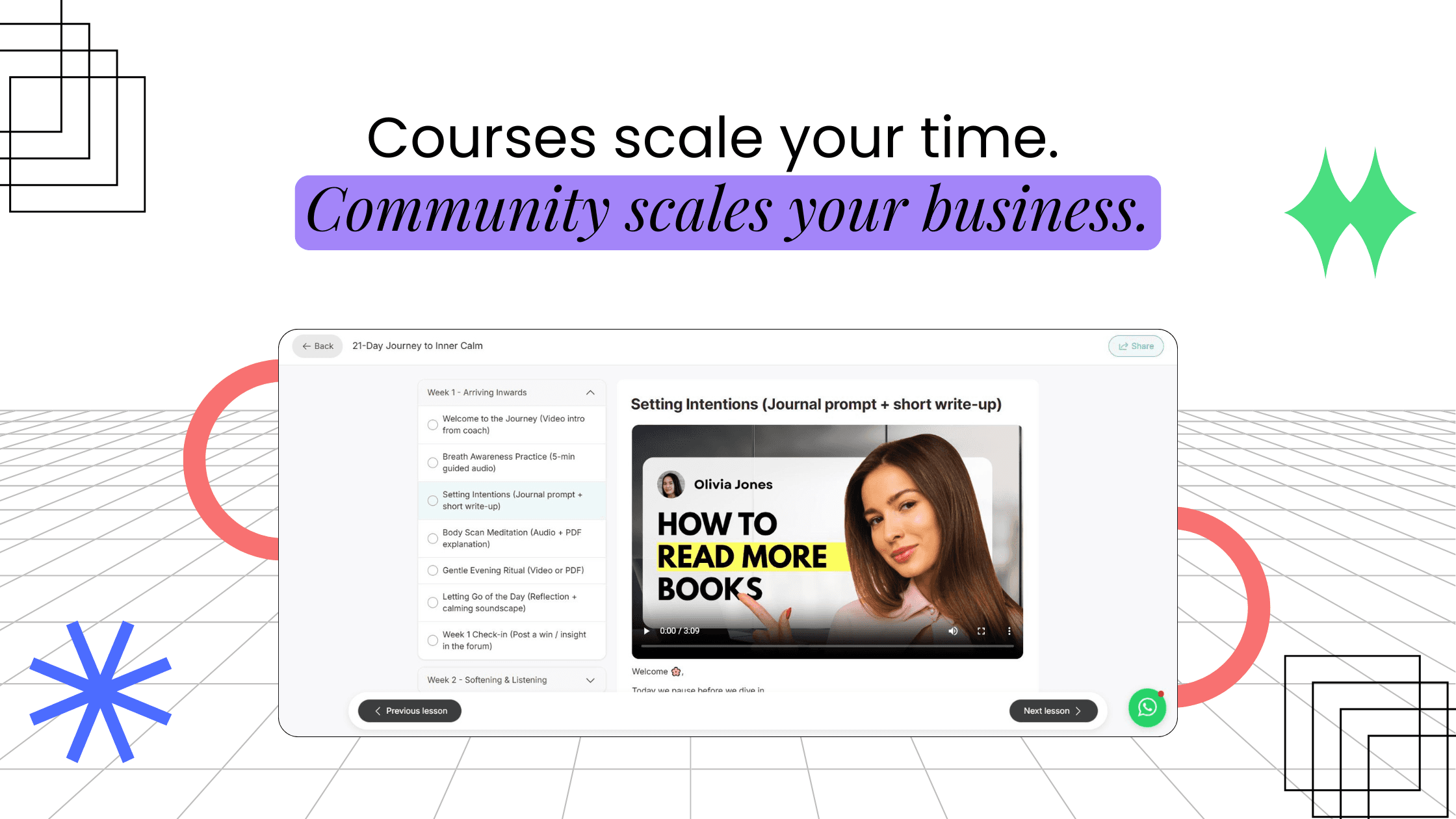
The best courses don’t live as just links and videos. They live in a guided learning hub with: Community, Accountability, Progress tracking, Private space for every cohort and each student.
Wylo helps you host courses, coaching, chat, events, payments, and community, all in one place, fully branded.
Try Wylo free and turn your course into a scalable business: Create My Course Hub with Wylo

About the Author - Omnath
Founder of Wylo, a highly comprehensive and customizable community platform for coaches, brands, and creators. Omnath helps coaches build structured, scalable, community-driven businesses through simple systems, clear frameworks, and high-quality client experiences.