Coaching business
How to Convert Your Audience Into Paying Coaching Community Members
Having an audience is one thing. Monetizing them is another. This guide shows coaches exactly how to bridge that gap, using smart positioning, trust-building content & a community that converts followers into paying members.
Contents
If you’re trying to convert your audience to paying community members, you’re likely facing a frustrating gap: people follow you, engage with your content, and say they get value, yet very few are willing to pay to join your community.
This is where most creators, coaches, and educators get stuck. And the common advice rarely works.
Having an audience is not the same as having members. Attention doesn’t automatically turn into commitment. And value alone isn’t enough to sustain a paid online community.
The reason most audiences don’t convert isn’t pricing, persuasion, or promotion. It’s structural. Audiences are designed to consume. Communities require participation. When the underlying structure doesn’t change, monetization feels forced and people opt out.
Here’s the critical reframe: People don’t pay for access. They pay for commitment, continuity, and outcomes.
Monetization doesn’t come from convincing an audience to pay. It comes from designing an environment where participation makes sense, progress is visible, and staying engaged creates real momentum.
This is the same system-level shift we explore in depth when building a scalable coaching business, one that grows through structure, not pressure.
This guide is not about sales tactics, pricing psychology, or launch funnels. It’s about understanding why conversion fails for most audiences, what actually makes people pay to be part of a community, and what needs to exist before monetization works.
If you already have an audience and want to turn it into a sustainable, paid community without resorting to hype or hard selling, this article will give you complete clarity before you take action.
TL;DR - Quick Summary
Most audiences don’t convert because they’re built for consumption, not participation
People don’t pay for content or access, they pay for commitment, continuity, and progress
Monetization works only after participation patterns and shared outcomes are in place
A paid community succeeds when structure changes before pricing does
Converting an audience requires designing for membership, not selling harder
Why Most Audiences Don’t Convert into Paid Communities
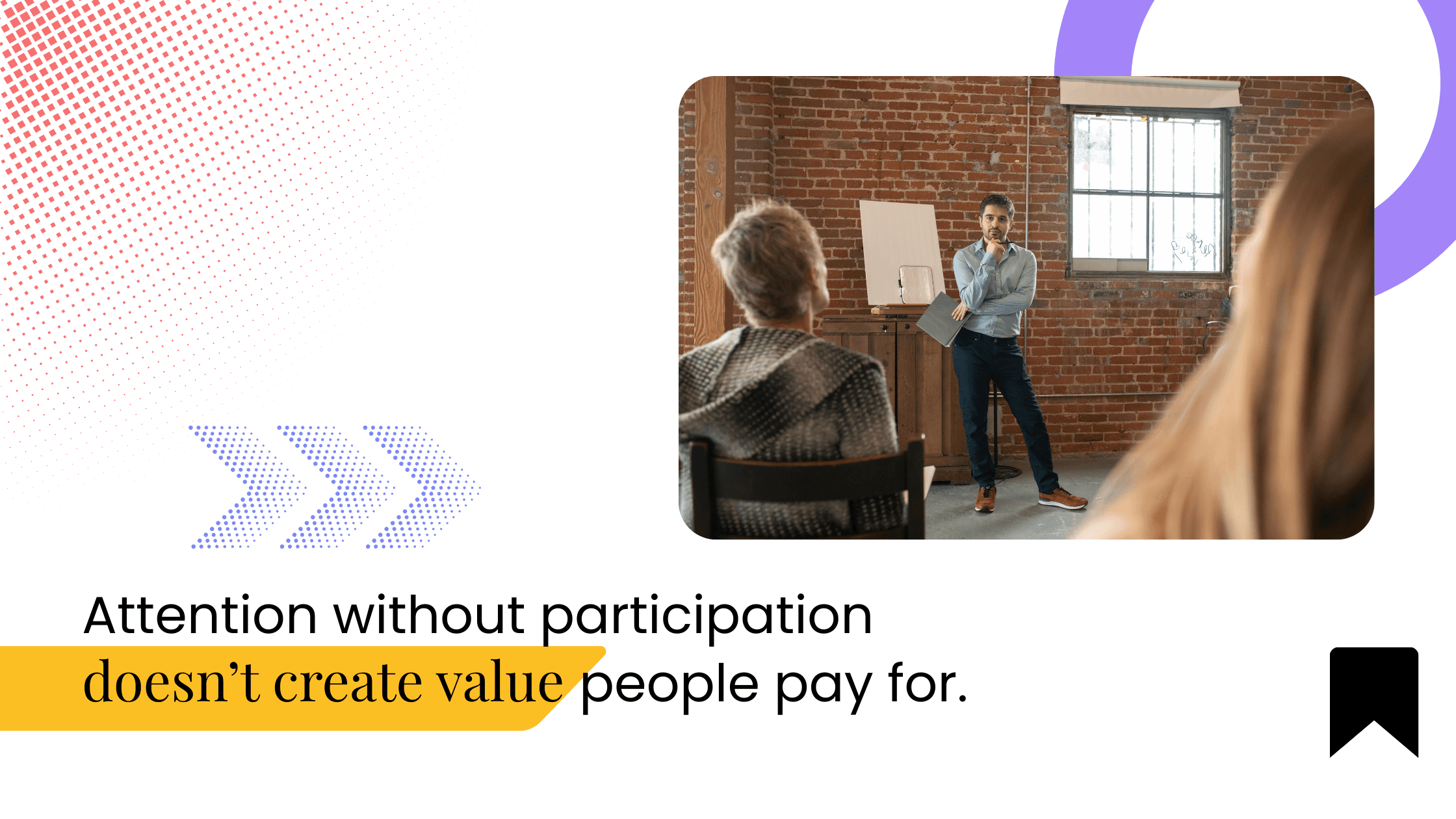
When coaches and creators ask why people won’t pay, the problem is rarely a lack of value. In most cases, it’s a mismatch between how the audience is trained to behave and what a paid community requires. This gap explains why people don’t pay for communities, even when the content is good and trust already exists.
Audiences Are Trained to Consume, Not Commit
Most audiences are built on one-way value.
People read posts, watch videos, and scroll updates with no obligation to participate. The relationship is passive by design. There’s no expectation of contribution, accountability, or follow-through.
When you ask that same audience to pay, you’re asking them to change behavior, not just spend money. Without a shift from consumption to participation, conversion stalls. This is the first reason why communities fail to monetize.
No Continuity Means No Reason to Pay
Audiences experience value in isolated moments.
A post is helpful. A video is insightful. Then it’s over.
Paid communities, on the other hand, rely on ongoing relevance. Members pay when progress continues over time, not when value appears occasionally. If there’s no clear sense of what happens next, payment feels unnecessary.
Without continuity, an audience sees no reason to move from free attention to a paid member in a community.
Free Value Does Not Create Paid Responsibility
Providing free value builds trust, but it doesn’t build responsibility.
In free environments, people engage on their own terms. They drop in and out without consequence. There’s no expectation to show up, apply insights, or stay accountable.
Payment changes that dynamic. It creates commitment. But if the structure doesn’t support responsibility, through participation, feedback, or shared progress, charging feels arbitrary rather than justified.
Passive Engagement Doesn’t Convert
Likes, views, and comments are often mistaken for readiness.
Passive engagement signals interest, not investment. It shows that people enjoy consuming what you share, not that they’re willing to commit time, energy, or money.
Conversion happens only when engagement becomes active, when people ask questions, help each other, and rely on the space for progress. Until that shift occurs, attempts to monetize will feel forced.
The Core Problem Behind Failed Conversions
Most failed paid communities don’t fail because of price or promotion. They fail because the audience was never prepared to become members.
Understanding this distinction is the first step toward building a community where people are willing to pay for, not by selling harder, but by changing how value is experienced and shared.
Audience vs Community - The Difference That Changes Conversion
The biggest shift in monetization doesn’t happen at the pricing level. It happens at the identity level. Until you understand the difference between an audience and a community, it’s almost impossible to move from an audience to a paid community in a way that feels natural.
Most failed conversions come from treating these two things as interchangeable. They’re not.
Audience = Consumption + Attention
An audience is built around content.
People follow, subscribe, and consume what you share. The relationship is directional: value flows from creator to audience. Engagement is optional, lightweight, and easily replaced.
Attention is the currency here. And attention, by itself, is not something people pay for.
This is why even large audiences struggle to monetize through community. Consumption creates familiarity, not commitment.
Community = Participation + Identity
A community is built around participation.
Members don’t just consume; they contribute, reflect, and support each other. The value doesn’t come only from the creator, but from the collective experience of being part of the group.
Identity becomes the currency. People stay because they see themselves as members, not just followers. Progress happens through shared effort, not isolated insight.
This is the fundamental shift required when turning an audience into members.
Why People Pay for Belonging and Progress
People rarely pay for access alone.
They pay to belong to something that matters and to move forward alongside others with similar goals. A community creates a container for continuity, accountability, and shared momentum, things an audience can’t provide by design.
When participation replaces passive consumption, payment stops feeling like a transaction. It becomes a commitment to progress.
The Conversion Insight Most People Miss
Audiences are optimized for reach whereas communities are optimized for transformation.
When you try to monetize an audience without changing the underlying structure, conversion feels forced. When you redesign for participation and identity, monetization becomes a natural next step.
This is the difference that changes everything, not a tactic, but a shift in how value is created and experienced.
What Actually Makes Someone Pay to Join a Community
When people ask ‘does paid community work’, they’re usually looking for proof that charging won’t scare everyone away. In reality, paid communities fail or succeed for reasons that have very little to do with price. Paid community conversion happens when people clearly understand what changes for them after they join.
Here’s what actually drives that decision.
Outcome Clarity: What Changes After Joining
People don’t pay to be inside a community. They pay for what becomes possible because they’re inside it.
Successful communities make outcomes obvious:
What problems will members solve?
What progress will they make over time?
What will feel different eight weeks or four months in?
When outcomes are vague, payment feels risky. When outcomes are clear and repeatable, payment feels rational. This clarity does more for conversion than any pricing strategy ever could.
Ongoing Relevance Beats One-Off Value
One of the biggest misconceptions about monetization is that people pay for a bundle of value upfront.
They don’t.
They pay when value continues to compound. A paid community works when members feel that:
Today’s participation helps tomorrow’s progress
Missing a week means falling behind
Staying engaged keeps paying off
If value feels occasional or optional, payment feels unnecessary. Ongoing relevance is what turns interest into commitment.
Peer Access Is More Valuable Than Content
Content is easy to find. Peers are not.
Most people don’t just join paid communities for lessons, posts, or resources. They join to learn alongside others who are facing similar challenges and making similar decisions.
Access to peers creates:
Faster learning through shared experience
Normalization of challenges
Motivation through visible progress
This is why peer access consistently outperforms content access in paid community conversion.
Identity and Accountability Loops Drive Commitment
Payment is often less about money and more about identity.
When someone joins a paid community, they’re not just buying access, they’re declaring intent. They’re saying, “This matters enough for me to show up.”
Accountability loops reinforce that identity:
Progress is visible
Participation is expected
Momentum builds socially, not privately
These loops are what make paid communities work. Without them, payment feels arbitrary. With them, payment becomes a commitment to follow through.
This Is Why Paid Communities Work
Paid communities succeed because structure, participation, and outcomes are aligned.
When a community is designed around progress, relevance, and shared accountability, payment stops being the barrier. It becomes the mechanism that makes the experience work.
Free vs Paid Community - Where Conversion Really Breaks
The debate around free vs paid community often focuses on reach, accessibility, or audience size. But conversion doesn’t break at the pricing layer. It breaks much earlier, at the behavior layer.
Free and paid communities don’t just differ in cost. They train people to show up in completely different ways.
Why Free Communities Train Passivity
Free communities lower the barrier to entry, but they also lower the bar for participation.
When there’s no cost to join, there’s no cost to disengage. Members drop in, skim conversations, and leave without consequence. Lurking becomes the default behavior, not contribution.
Over time, this trains passivity. Even highly motivated people wait to be pulled in rather than stepping forward. This is why many large free communities feel quiet, shallow, or dependent on constant prompting.
Why “Free First, Paid Later” Often Fails
The idea sounds logical: build a free community, prove value, then introduce a paid tier.
In practice, it can backfire.
A free environment sets expectations. People learn how much effort is required, how visible participation is, and what level of commitment is normal. When you later introduce payment, you’re asking them to change both behavior and mindset at the same time.
For many, that feels like friction rather than progression. This is one of the most common reasons conversion stalls in the free-to-paid transition.
How Payment Changes Behavior, Not Just Revenue
Payment is not just a monetization lever. It’s a behavioral filter.
When someone pays, they’re more likely to:
Show up consistently
Participate actively
Take responsibility for progress
Stay engaged over time
This isn’t about exclusivity or gatekeeping. It’s about alignment. Paid communities attract people who are ready to commit, not just observe.
This is where conversion really breaks or works. A paid structure supports accountability and momentum in ways a free structure simply can’t.
The Real Difference That Drives Conversion
Free communities optimize for access. Paid communities optimize for outcomes.
When the goal is transformation, not reach, payment becomes part of the system that makes the experience effective. Understanding this distinction is key to designing a community people are willing to join and stay in.
The Community Business Model That Actually Converts
Most advice around community monetization strategy focuses on tactics: pricing tiers, paywalls, launch sequences. But conversion doesn’t happen because of how you charge. It happens because of what the system does once someone joins.
A community business model that converts is designed around participation, continuity, and retention, not volume or hype.
This only works when the community sits inside a scalable coaching business model, where delivery systems are designed to compound value over time.
Conversion Follows Structure, Not Persuasion
People don’t decide to pay because they were convinced harder. They pay because the community‘s structure makes the value obvious before the transaction.
In communities that convert well:
Value is experienced continuously, not once
Progress is visible, not hypothetical
Participation is the default, not optional
When structure is right, conversion becomes a natural next step rather than a sales event.
Continuous Value Loops (Not One-Time Benefits)
High-converting communities are built around loops, not features.
A value loop looks like this:
A member asks a question or shares context
The community responds with insight, examples, or feedback
The member applies, reports back, and refines
That experience becomes reference value for others
This loop repeats daily or weekly. The more it runs, the more valuable the community becomes. This is the foundation of effective monetizing online community models: value that compounds through use, not content that expires after consumption.
Participation-Driven Design
In communities that convert, participation isn’t a bonus. It’s the product.
Design choices that reinforce this:
Conversations matter more than content drops
Visibility encourages follow-through
Progress is shared, not hidden
This shifts the member mindset from “What do I get?” to “How do I engage?”
When people see that progress depends on showing up, payment feels like an entry point into momentum, not a fee for access.
Retention Over Acquisition
The strongest community monetization strategy prioritizes retention before growth.
Instead of asking: “How do we get more people in?”
It asks: “How do we make this indispensable for the people already here?”
Retention-driven communities convert better because:
Social proof comes from active members, not testimonials
New members see real engagement immediately
Long-term relevance replaces short-term excitement
When members stay, conversion pressure drops. The community sells itself through lived experience.
Why Conversion Happens Once the Right Model Is Right
Paid conversion is an outcome, not a starting point.
When:
Value persists beyond any single session or post
Participation is designed into the experience
Members see ongoing relevance and progress
…then paying becomes logical. Not aspirational. Not risky.
This is why communities fail to convert when monetization is added too early and why they convert easily once the community business model is aligned with how people actually change, grow, and commit.

When Monetization Starts to Feel Natural
One of the most common questions creators and coaches ask is “Should I monetize my community now?” The hesitation is understandable. Charging too early feels risky. Charging too late leaves value on the table.
The shift to coaching community monetization feels natural only when the right signals are already present. These signals don’t come from audience size or revenue goals. They come from behavior.
Use the checklist below to assess readiness with clarity, not pressure.
Repeated Questions Across Your Audience
When the same questions surface again and again, it’s a sign of shared need.
This often shows up as:
Similar DMs across platforms
Comment threads circling the same challenges
Live sessions dominated by familiar topics
At this stage, people aren’t just consuming your content. They’re looking for continuity and follow-through. A paid community for coaches becomes relevant because it turns repeated one-off answers into a shared, persistent space for progress.
Peer Advice Is Already Happening
Monetization starts to feel easier when you notice something subtle: your audience is helping themselves.
This might look like:
Members replying to each other in comments
Community members referencing past discussions
Shared language or frameworks emerging organically
When peer advice already exists, a membership community for coaches isn’t creating demand. It’s organizing and sustaining what’s already happening.
There’s a Clear Desire for Continuity
Audiences convert when they want more than access.
Signals of continuity include:
“What should I do next?” questions
Requests for follow-ups or deeper discussion
Engagement that continues beyond a single post or session
This is where coaching community monetization stops feeling like selling and starts feeling like responding. People aren’t paying for content. They’re paying to stay for the progress.
Outcomes Extend Beyond Content
Content can spark insight. Communities support change.
Monetization feels natural when:
People apply what you share and report back
Progress unfolds steadily even if slowly
Results improve through iteration and accountability
At this point, charging isn’t about access to information. It’s about sustaining an environment where outcomes continue to evolve. That’s the foundation of any durable paid community for coaches.
Why These Signals Matter More Than Timing
Monetization works when it reflects existing behavior.
If your audience is already:
Asking similar questions
Learning from each other
Seeking continuity
Applying insights over time
…then a paid model isn’t a leap. It’s a formalization.
That’s when monetization stops feeling forced and starts feeling like the next logical step in how your community already operates.
Common Mistakes That Kill Paid Community Conversion

Most failures in paid community conversion don’t happen because people won’t pay. They happen because the community is monetized in a way that breaks trust, momentum, or relevance.
Understanding these mistakes early is essential if you want to succeed at monetizing an online community without damaging engagement or long-term retention.
Selling Access Instead of Outcomes
One of the fastest ways to stall conversion is positioning the offer as access.
Access to:
a platform
a group
exclusive content
Access alone doesn’t answer the real question in a buyer’s mind: what changes for me after I join?
High-converting paid communities are outcome-oriented. They make it clear how participation leads to progress, whether that’s clarity, accountability, speed, or results. When the focus stays on access, conversion drops because access feels abstract and simple, not valuable enough.
Locking Content Instead of Enabling Participation
Another common mistake is treating monetization like a paywall.
Content gets locked.
Value gets gated.
Interaction stays optional.
This approach assumes people pay for information. In reality, paid community conversion happens where people pay for involvement. Communities grow stronger through questions, discussion, feedback, and shared experience, not static resources.
When monetization restricts participation instead of supporting it, engagement declines and churn rises.
No Onboarding or Activation Path
Many paid communities fail quietly because new members don’t know what to do next.
Without onboarding:
People join, then lurk
Momentum never forms
Early excitement fades
Monetizing an online community without an activation path leaves value undiscovered. Successful communities guide new members toward their first meaningful action, whether that’s an introduction, a prompt, or a small win that reinforces why they joined.
Conversion isn’t complete at checkout. It’s complete when participation begins.
Asking for Money Before Commitment Exists
Perhaps the most damaging mistake is charging before commitment is established.
If your audience:
hasn’t experienced transformation
hasn’t interacted with peers
hasn’t felt continuity
…then payment feels premature.
Paid communities convert best after people are already invested. Commitment comes first. Monetization follows. Reversing that order leads to resistance, refunds, or disengaged members.
Why Avoiding These Mistakes Matters
None of these errors mean paid communities don’t work. They mean the structure is misaligned.
When monetization is layered on top of participation, clarity, and shared progress, conversion feels natural. When it’s imposed before those elements exist, even strong audiences struggle to convert.
Avoiding these mistakes doesn’t just protect conversion. It protects the community itself, ensuring growth comes from engagement, not pressure.
FAQs about Paid Communities
Does a paid community actually work?
Yes, a paid community works when people are paying for ongoing progress, not just access. Communities fail when they monetize attention or content. They succeed when participation, accountability, and relevance continue over time. In those cases, payment reinforces commitment rather than creating friction.
When do you convert an audience into paying community members?
Conversion happens best when an audience is already experiencing value through participation, not just consumption. When people ask recurring questions, learn from each other, and want continuity, the shift from audience to members becomes natural. Monetization works well once commitment is established, not before.
Is a free community required before launching a paid one?
No. A free community is not a prerequisite. In many cases, free communities train passivity and weaken conversion. What matters more than “free first” is whether people already trust your outcomes and want continued support. In most cases, paid communities convert better when the expectation of commitment is clear from the start.
Why do people leave paid communities?
People leave when value feels static or unclear. This usually happens when communities focus on locked content instead of participation, lack onboarding or activation, or stop feeling relevant to members’ current challenges. Retention depends more on ongoing engagement than on how much material is available.
Can small audiences be monetized successfully?
Yes. A large audience is not required to monetize a community. Small, focused audiences with shared problems and active engagement often convert better than large, passive ones. What matters is alignment and participation, not follower count.
Note: Communities differ from group programs and group coaching. While group coaching vs community models both involve multiple participants, communities scale through ongoing peer interaction rather than time-bound facilitation, which is why they are monetized differently.
Final Takeaway - Conversion Is a System, Not a Pitch
Converting an audience into paying community members isn’t about better persuasion or stronger selling. It’s about structure.
People don’t pay because they were convinced. They pay because commitment already exists and payment becomes an extended step, not a leap.
When conversion fails, it’s rarely because the audience wasn’t big enough or the price was wrong. It’s because the system underneath didn’t support participation, continuity, or progress.
Monetization works when:
Value is ongoing, not one-off
Engagement is active, not passive
Progress is shared, not isolated
In other words, design comes before pricing.
If you’re serious about turning an audience into a paid community, the next step isn’t charging, it’s designing the environment where people naturally show up, contribute, and want to stay.
That’s exactly what we’ll break down next - how to create a paid membership community for coaching clients, with structure, experience, and long-term retention coming first.
If you’re already thinking about how to implement this in practice, some coaches choose to prototype these participation and commitment loops inside a small, private community before scaling.
Platforms like Wylo are built specifically around this system-first approach, focusing on engagement, continuity, and member experience rather than just content access.
You can explore that path when you’re ready. Always remember, the structure always comes first.

About the Author - Omnath
Founder of Wylo, a highly comprehensive and customizable community platform for coaches, brands, and creators. Omnath helps coaches build structured, scalable, community-driven businesses through simple systems, clear frameworks, and high-quality client experiences.