Coaching business
Real Reasons Why Clients Lose Motivation in Coaching Programs
Coaching clients don't lose motivation because they lack commitment. But because coaching programs lack reinforcement between sessions. This article breaks down the structural causes of drop-offs & how to fix them.

Contents
Many coaches wonder why coaching clients lose motivation even after strong sessions and clear action plans. The pattern is familiar across all types of coaching programs from business coaching to fitness coaching: energy is high on the call, but client engagement fades a few days later. It’s tempting to assume the client isn’t committed enough. In reality, motivation isn’t the root problem.
Most coaching clients lose motivation not because they lack commitment, but because coaching programs lack reinforcement between sessions.
Sessions create clarity, but clarity alone doesn’t sustain behavior. When progress depends entirely on what happens inside a weekly conversation, momentum becomes fragile. Without structure between sessions, effort feels isolated and inconsistent. A well-designed community changes that dynamic by carrying engagement forward, reinforcing action, and making participation visible.
If you're still evaluating whether adding a community layer makes sense, start with What Is a Coaching Community and Why You Need One to understand the foundation behind this model.
This article builds on that foundation and explains what actually causes motivation drop-off and how a community-based structure keeps clients consistent without constant reminders.
TL;DR
Coaching clients lose motivation when the momentum from sessions has nowhere to go. Insight isn’t the issue; reinforcement is. When action is private, optional, and invisible between calls, follow-through drops. A community fixes this by creating structure between sessions: shared rhythm, visible progress, and lightweight accountability that keeps clients engaged without constant reminders.
Why Coaching Clients Lose Motivation
Understanding why coaching clients lose motivation requires looking into structure beyond mindset.
In many coaching programs, motivation feels strong during sessions but unstable between them. The issue isn’t that clients stop caring. It’s that the environment stops reinforcing the action.
When there’s no system carrying behavior forward, engagement weakens and coaching program drop off becomes predictable.
This is the hidden reason why clients lose motivation in coaching programs, not because they lack commitment, but because momentum isn’t supported consistently.
Motivation Fades Without Reinforcement
Right after a session, energy is high. Clients leave with clarity, renewed focus, and specific next steps. For a short window, action feels easy.
Then reality returns. Within 24 to 48 hours, distractions compete for attention. Without reinforcement, the urgency fades. The plan is still there, but the emotional charge behind it isn’t. If nothing in the coaching environment brings that intention back into view, action quietly slows down.
This is where client consistency in coaching begins to weaken. Not dramatically. Gradually. Small missed actions turn into missed updates. Missed updates turn into reduced participation. Over time, this is how coaching program drop off begins, not with a decision to quit, but with a gradual loss of reinforcement.
Sessions Create Spikes, Not Stability
Coaching is often structured as a series of powerful conversations. Each session generates insight, direction, and accountability. But those conversations are episodic.
Behavior, on the other hand, requires repetition.
When progress depends entirely on what happens inside a weekly call, clients experience motivational spikes rather than steady momentum. They feel clarity in the moment, but without repetition between sessions, clarity doesn’t solidify into routine.
Insight without repetition fades.
This pattern explains much of the frustration coaches feel. The session worked. The client understood. But understanding alone doesn’t sustain action. Stability comes from repeated reinforcement, not isolated breakthroughs.
Isolation Weakens Commitment
Between sessions, most clients work alone. They test ideas privately, struggle quietly, and second-guess themselves without visibility. There’s no shared reference point, no real-time feedback loop, and no sense that others are moving alongside them.
When effort is invisible, hesitation grows. Small setbacks feel personal instead of normal. Clients begin to wonder if they’re falling behind. That internal doubt often turns into silence. Silence reduces engagement. Over time, this is why clients quit coaching, not because they rejected the process, but because they felt disconnected from it.
Isolation doesn’t eliminate motivation instantly. It erodes it slowly.
Progress Feels Invisible
Another overlooked reason why coaching clients lose motivation is that progress often isn’t visible. Clients make incremental improvements, but without acknowledgment, those improvements don’t register emotionally.
Effort that isn’t seen feels uncertain. Without a feedback loop, even a simple acknowledgment, momentum becomes unclear. Clients aren’t sure if they’re moving fast enough, doing enough, or improving enough. That ambiguity weakens follow-through.
When progress remains private and unrecognized, engagement becomes fragile. Motivation becomes dependent on internal drive alone. And internal drive fluctuates.
The pattern is consistent across coaching programs: when reinforcement is missing, sessions become isolated events, effort becomes invisible, and consistency begins to slip.
Why More Accountability Doesn’t Fix It
When motivation drops, the default response in many coaching programs is to increase accountability. Add more check-ins. Send more reminders. Follow up more aggressively. On the surface, this sounds logical. If clients aren’t following through, tighten the system.
But more accountability in coaching programs doesn’t automatically create consistency. In fact, when accountability is layered on top of a weak structure, it often increases pressure without increasing momentum.
Accountability is powerful when it reinforces action, but useless when it becomes a replacement for action.
Reminders Create Pressure, Not Momentum
Reminders are a form of external push. As the coach, you nudge. Clients respond. For a short period, compliance improves. Tasks get done. Updates are sent.
But this pattern relies on the coach as the driver of energy.
When reminders are the primary tool for accountability, follow-through becomes reactive. Clients act because they were prompted, not because the environment supports ongoing action. There’s no intrinsic reinforcement loop. Once the reminder stops, the behavior often stops with it.
Momentum requires internal and environmental reinforcement. Reminders only create temporary movement.
Check-Ins Become Reporting
Structured check-ins can help. But when they are framed as performance updates rather than as participation rituals, they shift the program's emotional tone.
Instead of sharing progress openly, clients start reporting outcomes. The energy changes from collaborative to evaluative. Subtle performance pressure enters the dynamic. Clients begin to wonder if they are doing “enough.”
When progress feels like it’s being judged, hesitation grows. If a week goes poorly, avoidance becomes easier than explanation. That’s how check-ins quietly turn into silence.
Accountability should lower friction. When it increases self-consciousness, it undermines the very engagement it was meant to protect.
Over-Coaching Creates Dependency
Another common response to declining motivation is increased involvement from the coach. More feedback. More follow-ups. More direct intervention.
In the short term, this can lift engagement. But it also shifts the source of momentum entirely onto you. As the coach, you become the energy source. The system itself doesn’t carry behavior forward.
When progress depends on your presence, consistency becomes fragile. If you are less available, energy dips. If the client doesn’t receive immediate reinforcement, action slows.
This dynamic also carries a risk for you. Sustaining motivation through constant intervention isn’t scalable. It increases cognitive load and eventually leads to burnout.
More accountability doesn’t solve the underlying issue. If the environment between sessions remains passive, pressure increases while reinforcement remains weak. And pressure alone is not a durable substitute for structure.
What a Coaching Community Changes
The shift happens when coaching stops being a series of isolated sessions and becomes an environment. A community-based coaching model doesn’t try to increase motivation directly. It changes the conditions around behavior.
Instead of relying on private effort between calls, it introduces shared visibility, predictable rhythm, and lightweight interaction. That’s what turns group coaching accountability from pressure into participation. It also explains why group coaching motivation often feels more stable than one-to-one models built only around conversations.
The difference isn’t more energy. It’s more reinforcement.
Visibility Replaces Willpower
In traditional coaching, progress is mostly private. Clients act alone, reflect alone, and return to report results. If the week goes well, they share success. If it doesn’t, they often show up with less clarity or less confidence.
Inside a community, behavior becomes social. Effort is seen in real time. Small updates, shared reflections, and visible participation create a subtle but powerful effect: showing up feels normal.
When effort is visible, it gains weight. A short update isn’t just a task completed; it’s a signal of movement. Others see it. Sometimes they respond. Sometimes they mirror it. Consistency stops depending purely on willpower and starts depending on pattern.
When participation is visible, it becomes easier to repeat.
Peer Momentum Sustains Action
Motivation becomes fragile when it depends on a single relationship. In session-only coaching, the coach is the primary source of direction and reinforcement. Between sessions, energy can dip because nothing else is moving.
In a community setting, movement is distributed. Clients see others progressing, asking questions, sharing wins, and navigating setbacks. There is a shared rhythm to participation. Reflection happens at similar intervals. Updates appear consistently. Conversations resurface.
That rhythm creates social pull. When others are moving forward, inertia feels less natural. No one is forcing participation, but engagement feels aligned with the group’s pace. This is where group coaching accountability becomes self-sustaining rather than externally enforced.
Momentum builds because the environment continues moving, even when individual motivation fluctuates. Live touchpoints accelerate this effect. This dynamic is central to How Events Improve Relationships in a Coaching Community, where structured events deepen connection and reinforce participation loops.
The Space Between Sessions Becomes Active
Most coaching programs treat the time between sessions as a gap. Action is expected, but the structure is thin. Clients are given direction, then left to implement privately.
A community changes that.
Coaching support between sessions is where transformation stabilizes.
Instead of a silent stretch of time, the space between calls becomes active. Clients revisit insights through short reflections. They share progress as it unfolds, not just at the next scheduled meeting. Small adjustments are acknowledged quickly, which keeps momentum from stalling.
This active layer also creates recovery moments. If a week slips, the next opportunity to engage is already visible. There’s no dramatic restart. Just a return to rhythm.
In a community-based coaching model, transformation doesn’t rely on isolated bursts of clarity. It is reinforced between sessions through visibility, shared cadence, and consistent interaction. That reinforcement, not motivation alone, is what makes progress durable.

How to Keep Coaching Clients Motivated (Without Forcing It)
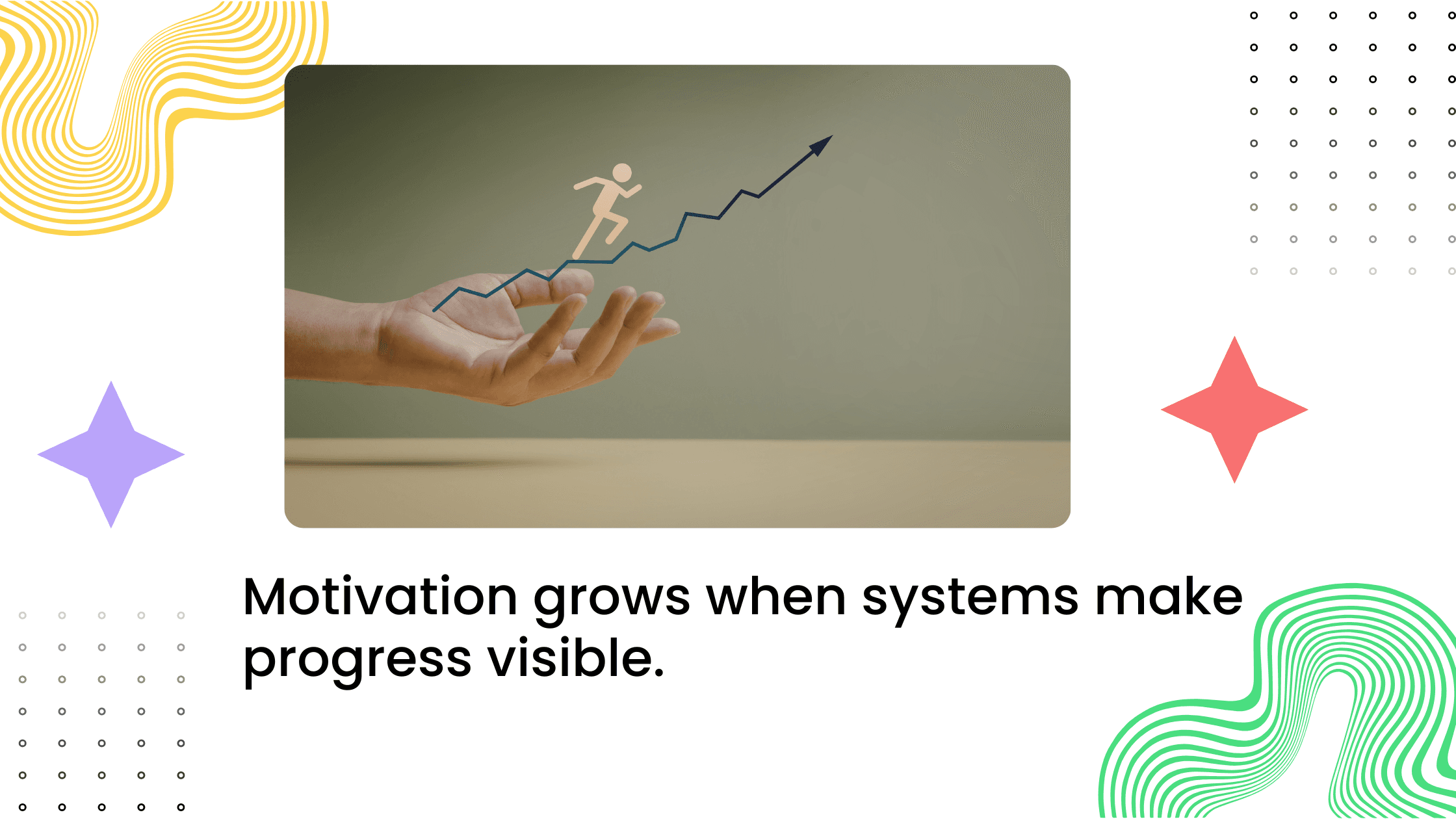
When coaches search for how to keep coaching clients motivated, they’re often looking for better prompts, stronger accountability, or more inspiring delivery. But sustainable motivation doesn’t come from pushing harder. It comes from redesigning the environment.
If you’re wondering how to motivate coaching clients, the answer isn’t more intensity. It’s better structure. Coaching program engagement improves when participation is predictable, progress is visible, and returning after an average week feels normal.
Motivation stabilizes when the system carries it. It’s also the idea behind 9 Ways to Increase Engagement in a Coaching Community, which centers on the participation patterns that sustain consistent involvement.
Design Predictable Participation
Consistency grows from rhythm. When clients know exactly when and how participation happens, hesitation decreases.
Predictable participation doesn’t mean rigid rules. It means there is a steady cadence to engagement. Reflection happens at familiar intervals. Updates follow a clear pattern. Clients don’t have to decide whether to show up; the moment to engage arrives naturally.
When rhythm is stable, motivation becomes less volatile. Instead of waiting to “feel ready,” clients move because the structure guides them. Predictability removes friction, and friction is often what drains momentum.
Make Progress Visible
If effort is private, it is quite fragile. But when visible, it is reinforcing.
When clients can see their own progress, and the progress of others, consistency becomes easier to maintain. Visibility loops don’t require elaborate tracking systems. They simply ensure that action doesn’t disappear into silence.
A short update, a shared reflection, a small acknowledgment. These signals compound. They create a sense of forward motion that keeps engagement alive.
Coaching program engagement strengthens when effort is recognized in real time, not just summarized in the next session. Visibility makes progress feel tangible. Tangibility sustains motivation.
Normalize Imperfect Weeks
Motivation drops fastest when clients believe they’ve “fallen behind.”
In many coaching environments, a missed action or skipped week creates subtle pressure. Returning feels uncomfortable. The longer someone waits, the harder it becomes to re-engage.
Normalizing imperfect weeks removes that pressure. A well-designed structure expects fluctuation. There is always a next entry point. Clients don’t need to justify absence. They simply step back into the rhythm.
This re-entry design protects motivation. It keeps small lapses from turning into full disengagement.
Protect the Between-Session Layer
Most coaching programs focus on improving the session. Fewer focus on strengthening what happens after it.
If you want to improve coaching program engagement, protect the space between sessions. That’s where repetition happens. That’s where insight turns into behavior. That’s where consistency is either reinforced or lost.
When the between-session layer is intentional, supported by rhythm, visibility, and easy re-entry, motivation doesn’t have to be forced. It’s sustained by structure.
If you’re building such a coaching layer from scratch, use Ultimate Checklist to Launch a Coaching Community in 30 Days to structure your rollout step by step.
For a deeper breakdown of how to design this layer intentionally, see Coaching Community Blueprint: Journey & Rituals That Work, where the client journey and reinforcement patterns are mapped step by step.
Motivation becomes stable when participation is embedded into the environment, not pushed onto the individual.
Common Reasons Coaching Programs Fail

When coaches search why coaching programs fail, the answers often point to marketing, pricing, or niche clarity. But failure inside the program usually looks different. It shows up as slow disengagement, missed participation, and eventual coaching program drop off.
Most programs don’t fail because the content is weak. They fail because consistency isn’t structurally supported. This pattern appears across many coaching environments - 7 Reasons Coaching Clients Lose Engagement & How to Fix It.
Coaching programs tend to struggle when:
Momentum exists only during sessions, not between them.
Participation depends on reminders instead of rhythm.
Progress stays private and unacknowledged.
Accountability feels evaluative rather than supportive.
Missing a week creates friction instead of a clean return point.
These patterns don’t cause immediate collapse. They cause gradual erosion. Engagement softens. Updates become shorter. Sessions feel repetitive or stale because implementation hasn’t continued between calls.
Over time, you work harder to maintain energy, while clients work harder to maintain motivation. The system becomes effort-heavy and reinforcement-light.
FAQs About Reasons For Coaching Clients Losing Motivation
Why do coaching clients lose motivation?
Coaching clients lose motivation when progress isn’t reinforced between sessions. Insight alone doesn’t sustain behavior. When coaching programs rely only on weekly conversations and leave the space between them unstructured, momentum fades. The issue isn’t commitment, it’s the absence of consistent reinforcement.
How do you keep coaching clients engaged?
To improve client engagement in coaching, focus on structure rather than inspiration. Engagement stabilizes when participation follows a predictable rhythm, progress is visible, and clients can re-enter easily even after slower weeks. When the environment supports repetition, consistency becomes easier to maintain.
Why do clients quit coaching programs?
Clients rarely quit because they reject the value of coaching programs. They disengage when the system doesn’t carry them forward between sessions. If progress feels invisible, accountability feels heavy, or returning after a missed week feels uncomfortable, participation gradually declines. Drop-off is usually structural, not personal.
Does group coaching improve motivation?
Yes, when designed intentionally. Group coaching motivation tends to be more stable because participation is visible and shared. Strong group coaching accountability distributes reinforcement across peers rather than concentrating it on the coach or the client themself. When effort is seen and rhythm is collective, consistency feels more natural.
Final Takeaway, Motivation Is a System Problem
Motivation fluctuates. Structure stabilizes.
Sessions spark clarity. Communities sustain behavior.
When coaching programs depend only on conversations, progress resets every week. When a coaching program includes a structured community layer, momentum continues between sessions. Participation becomes predictable. Effort becomes visible. Consistency becomes normal.
If you really want clients to stay consistent, design a coaching environment that carries them between sessions.
You can explore how Wylo helps coaches build structured, community-driven programs with a free trial and see how engagement changes when reinforcement is built into the system.

Senthil
Marketing Head of Wylo, a highly comprehensive and customizable community platform for coaches, brands, and creators. Senthil helps coaches design clear marketing systems, strong positioning, and sustainable monetization models through practical community frameworks and execution-first strategy.