Coaching business
How to Scale a Coaching Business Using an Online Community
Scaling a coaching business is about building the right systems. Discover how coaches move from 1:1 sessions to group programs & recurring revenue with an online community model.
Contents
Building a scalable coaching business becomes a real challenge once your calendar is full, clients are getting results, and yet your income feels capped.
You’re busy, booked, and delivering value, but growth has slowed because every new client still depends on your time.
This is the point where many coaches realise why 1:1 coaching doesn’t scale. More clients don’t create leverage. They create longer days, delivery fatigue, and an invisible coaching business income ceiling that effort alone can’t break.
This guide is not about marketing, getting more leads, or launching yet another offer. It’s about your delivery model, the system behind how transformation happens once clients are already inside your world.
If you already have paying clients and demand isn’t the problem, the question isn’t how to work harder.
It’s how to redesign your coaching business so growth no longer depends on more sessions.
Before we dive in, if you are just starting and want to get through the basics, explore our comprehensive coaching guide - The Complete Guide to Starting an Online Coaching Business (2025 Edition)
TL;DR (Quick Summary)
Most coaching businesses hit a growth ceiling because 1:1 delivery ties income directly to time
Group coaching improves leverage, but alone, it still depends heavily on your presence
True scale comes from changing the system of delivery, not adding more offers
Community acts as the missing layer that enables peer-led value, retention, and compounding outcomes
A scalable coaching business is built on systems, not sessions
The Hidden Income Ceiling in Most Coaching Businesses
Most coaches don’t hit a growth ceiling because they lack skill or demand. They hit it because their business is built on a time-for-money model that doesn’t stretch once their calendar fills up.
No matter how good your results are, there are only so many hours you can sell in a week.
This is the coaching business income ceiling: a point where effort increases, but revenue plateaus. You may feel busy, even successful, yet growth slows because every additional client still requires direct, personal delivery from you.
A scalable coaching business is one where client impact and revenue grow without a proportional increase in the coach’s time or delivery load.
When a coaching business isn’t structured this way, it creates delivery fatigue over time. Sessions stack up. Preparation, follow-ups, and mental context carry over from one client to the next.
Even when the work is meaningful, the constant demand on your attention limits how much energy you can give and how many clients you can sustainably support.
Another hidden constraint is context switching. Each client brings a different goal, problem, and emotional state. Moving between them multiple times a day fragments focus and increases cognitive load. The business may look full from the outside, but internally it becomes harder to maintain clarity and consistency.
The result is revenue volatility despite a full calendar. Income is tied to sessions delivered. Miss time, take a break, or slow down and revenue drops with it. There’s no buffer, no compounding effect, and no system carrying value forward when you step away.
This is the core challenge of coaching business scalability. When growth depends entirely on your presence, the business can’t expand without adding more hours, more strain, or both. Until the delivery model changes, the ceiling stays in place, regardless of how experienced or in-demand you become.
Why Scaling a Coaching Business Is Different from Scaling Other Businesses
Scaling a coaching business isn’t the same as scaling other types of online businesses. Many online models grow by creating something once and selling it repeatedly.
Coaching works differently because the value isn’t just in what is delivered; it’s in the ongoing relationship that supports change.
Coaching Is Relational and Ongoing
Coaching is built on continuity. Progress happens over time, through repeated interaction, reflection, and adjustment. Clients don’t just consume information; they apply it, struggle with it, and return with new questions. This makes coaching inherently relational, not transactional.
A scalable coaching business model has to account for this ongoing dynamic. Removing the relationship entirely may reduce effort, but it also weakens outcomes, which is why many coaches hesitate to move away from live delivery in the first place.
Transformation Doesn’t End When the Session Ends
Real transformation rarely happens inside a single call. It unfolds between sessions, in how clients implement ideas, stay accountable, and learn from others facing similar challenges. When delivery stops at the session itself, momentum fades and results become inconsistent.
This is where traditional scaling advice falls short. Telling coaches to “package their knowledge” ignores the fact that insight alone doesn’t create change. Without continuity and reinforcement, progress stalls, even if the content is high quality.
Content Alone Is Not Coaching
Courses, one-off programs, and info products are designed for distribution, not interaction. They scale well because they remove the need for ongoing involvement. But that same strength is also their limitation in a coaching context.
For many coaches, this explains why “just make a course” doesn’t work. Clients may enroll, but engagement drops quickly. Completion rates are low, questions go unanswered, and the sense of support that defines coaching disappears. From the business standpoint, upsells slow down.
Why This Matters for Coaching Business Scalability
A coaching business scalability problem can’t be solved by content alone. Scaling requires a model that preserves relationship, continuity, and application, without increasing direct time spent per client.
Until the delivery system supports ongoing transformation beyond individual sessions, growth will always be constrained. This is why coaching businesses need a different approach to scale, one that extends value without stripping away what makes coaching effective in the first place.
The Common Ways Coaches Try to Scale & Where They Break

When coaches start thinking about scale, they usually explore the same set of options. These approaches are widely discussed, easy to find, and often recommended on page-one results. Each one can help, but each also has clear structural limits that eventually slow growth.
Expanding 1:1 Coaching Capacity
The most common response to demand is to take on more private clients. This may include longer working hours, tighter schedules, or shorter sessions. In some cases, coaches add limited automation around scheduling or follow-ups.
Where it breaks:
This approach doesn’t change the underlying model. Revenue still scales linearly with time. As capacity fills, flexibility disappears, and growth stops once personal limits are reached.
Group Coaching Programs
Group coaching increases leverage by serving multiple clients at once. It introduces shared learning, peer accountability, and a more efficient use of live time.
For coaches considering this transition, understanding the shift from private delivery to shared formats is critical, which is why shifting from 1:1 to group coaching needs to be done intentionally.
Where it breaks:
Group programs are still delivery-heavy. They often depend on fixed cohorts, scheduled sessions, and repeated launches. When the program ends, momentum resets, and the coach remains the central driver of progress.
High-Ticket Intensives
Some coaches package their expertise into short, high-touch intensives or retreats. These can raise short-term revenue and reduce the number of clients required to hit income targets.
Where it breaks:
Intensives concentrate effort into narrow time windows. They’re difficult to repeat frequently and don’t create ongoing value. Revenue spikes, then drops, making long-term stability hard to maintain.
Courses and Digital Programs
Courses and digital products are often seen as the ultimate scaling solution. They’re created once and sold repeatedly, with minimal involvement after launch.
Where it breaks:
Content alone doesn’t sustain engagement or accountability. Many clients consume little, apply less, and disengage quickly. For coaches focused on transformation, this model often sacrifices outcomes for efficiency.
Why These Coaching Models Plateau
Each of these options improves efficiency in isolation, but none fully solve the core scalability challenge. They either remain dependent on live delivery or remove the relational elements that make coaching effective.
This is why many coaches feel stuck, they’ve tried the obvious paths, yet growth still feels fragile. The missing piece isn’t another offer. It’s a delivery system that compounds value instead of resetting it every time a program ends.
Why Group Coaching Alone Still Doesn’t Fully Scale
Group coaching is often presented as the solution to the limits of private sessions. Compared to 1:1 delivery, it increases leverage and reduces the number of live hours required per client. In many cases, it’s a necessary step forward. But group coaching scalability has its own constraints that become visible once programs mature.
Group coaching can still be a valuable step, but it works best when designed carefully, especially during launching a group coaching program for the first time.
Group Coaching Is Still Cohort-Dependent
Most group coaching programs run in fixed cohorts. Clients join together, move through a defined timeline, and finish at roughly the same time. This structure creates momentum, but it also means scale depends on repeatedly forming new groups.
Once a cohort ends, the value resets. To grow, the coach must launch again, onboard again, and start the process over. The business doesn’t compound; it moves in cycles.
Growth Relies on Repeated Launches
Because cohorts are time-bound, revenue becomes tied to launches. Even successful programs experience gaps between enrollments. Marketing activity spikes before each start date, then drops once the group begins.
This makes growth uneven and fragile. While group coaching improves efficiency compared to 1:1, it still requires constant effort to keep the pipeline full.
The Coach Remains the Central Bottleneck
In most group programs, the coach is still the primary source of insight, feedback, and accountability. Sessions may be shared, but delivery remains facilitator-heavy.
As groups grow larger, the quality of interaction can drop. As they stay small, scale is limited. Either way, the coach’s time and attention remain the constraint, which is why 1:1 coaching doesn’t scale, and group coaching only partially solves the problem.
Peer Value Has No Place to Persist
Group programs often generate powerful peer discussions during live calls. But once a session ends, those insights disappear. There’s no persistent space for questions, reflection, or peer-to-peer support to continue between sessions or after the program concludes.
Without continuity, clients rely on the coach again for momentum. The collective value created inside the group doesn’t accumulate over time.
What Group Coaching Means for Scale
Group coaching improves leverage, but it doesn’t create compounding scale on its own. It reduces effort per client, yet still depends on cohorts, launches, and facilitator presence to function.
To move beyond incremental efficiency and build a truly scalable coaching business, the delivery model needs a layer that allows value to persist, grow, and support clients even when the coach isn’t actively leading every interaction.
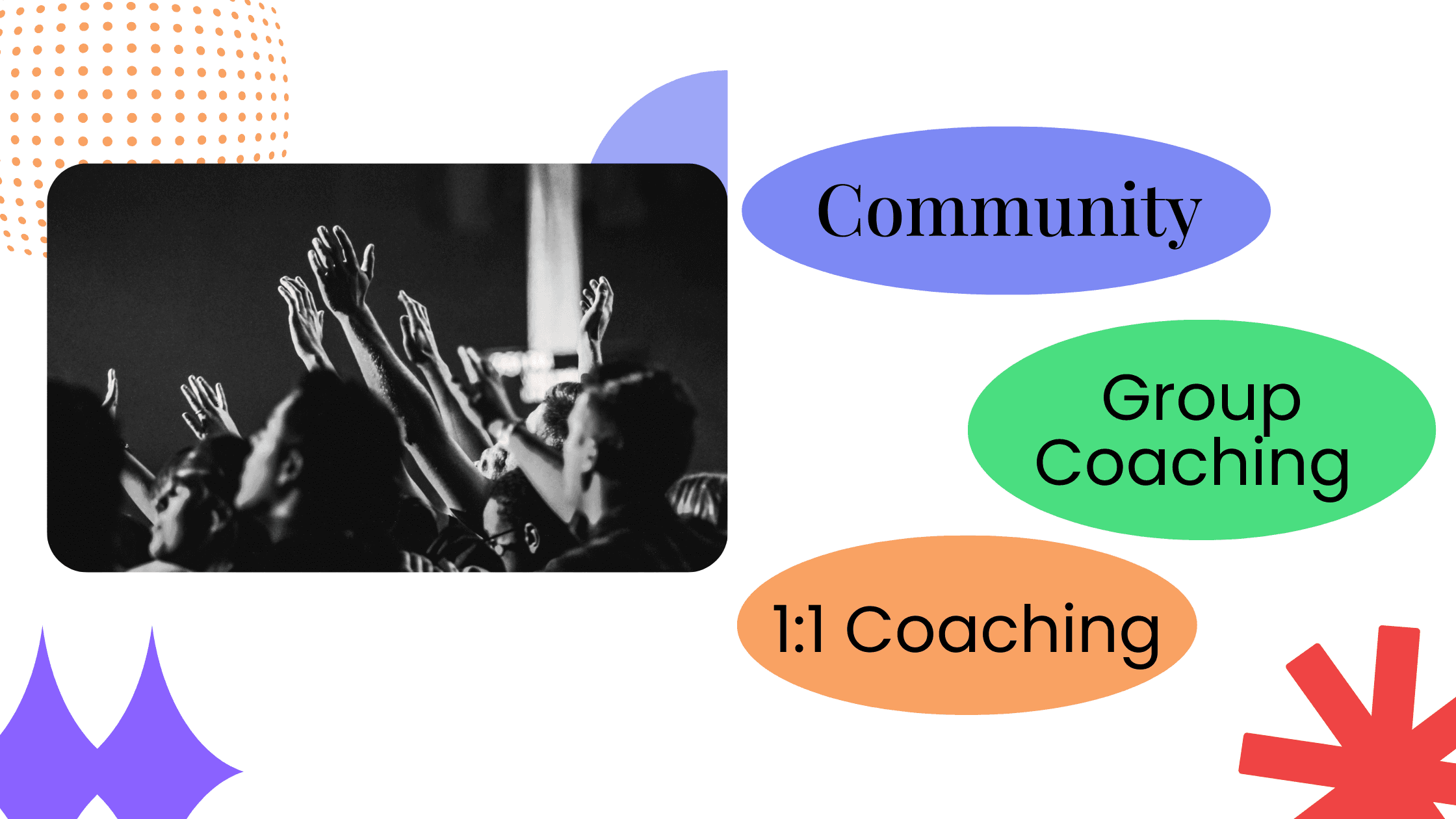
The Coaching Scale Ladder (A Scalable Coaching Business Model)
To understand what actually scales in coaching, it helps to stop thinking in terms of offers and start thinking in layers. Most coaches experiment randomly, adding group programs, then courses, then memberships, without a clear progression. The result is complexity without scale.
The Coaching Scale Ladder is a simple framework that shows how a coaching business evolves from high-touch delivery to sustainable, compounding growth. Each layer builds on the previous one, rather than replacing it.
This is the core of a scalable coaching business model, not a single tactic, but a system.
1. 1:1 Coaching - High Depth, Zero Leverage
Private coaching sits at the base of the ladder. It offers the highest level of personalization and the fastest path to client results.
Strength:
Deep insight into client problems
Strong outcomes and testimonials
Limit:
Every result depends on your direct time
No leverage, no compounding effect
This layer is essential, but it cannot scale on its own.
2. Group Coaching - Shared Leverage, Delivery-Heavy
Group coaching introduces leverage by serving multiple clients at once. It reduces time per client and creates shared learning.
Strength:
Better time efficiency
Peer learning during live sessions
Limit:
Still dependent on cohorts and schedules
Coach remains the primary driver of value
Group coaching improves efficiency, but delivery is still centralized around you.
3. Community Layer - Peer-Led, Compounding Value
The community layer completely changes the dynamics. Instead of all value flowing from coach to client, clients begin to support and learn from one another.
Strength:
Peer-to-peer problem solving
Knowledge persists beyond live sessions
Value compounds over time
Why this matters:
This is the first layer where growth is no longer tied directly to your availability. Transformation continues even when you’re not actively present.
4. Membership & Programs - Predictable Revenue
Once community exists, memberships and structured programs become sustainable rather than fragile. Clients stay longer because value is ongoing, not time-bound.
Strength:
Recurring, predictable revenue
Higher lifetime value per client
Dependency:
Without community, memberships struggle with churn. With community, they become durable.
This is why building a paid coaching membership works best when it sits on top of an active community rather than simply replacing one-off programs.
5. Ecosystem - Courses, Events, Extensions
At the top of the ladder sits the ecosystem: courses, workshops, events, certifications, and other extensions.
Strength:
Maximum leverage
Optional, not essential
Key insight:
These work best when they sit on top of an active community, not in isolation.
Why the Coaching Scale Ladder Works
This framework gives clarity to coaching business scalability. It shows why many scaling attempts fail - coaches jump layers instead of building them in order.
More importantly, it explains where real leverage comes from. Scale doesn’t appear when you add more offers. It appears when your delivery system allows value to persist, multiply, and support clients without relying entirely on your time.
Why Community Is the Missing Scale Layer
Most scaling strategies focus on offers. Community focuses on the system behind delivery. That difference is what makes community the secret layer in a truly scalable coaching business.
Community Is an Operating System, Not a Feature
In a scalable model, community isn’t something you “add on” to a program. It becomes the environment where learning, application, and support continue by default.
An operating system doesn’t replace your coaching. It runs it. Questions don’t wait for sessions. Insights don’t disappear after programs. Progress isn’t paused when the coach steps back. This is the structural shift that enables scalable coaching with community.
Community Is a Container for Peer Transformation
Coaching outcomes improve when clients learn they’re not alone. In a well-designed community-based coaching model, peers contribute context, examples, and encouragement that no single coach could provide at scale.
Over time, answers come from the group, not just the facilitator. Patterns repeat. Solutions resurface. Transformation becomes shared, and that shared momentum reduces dependency on constant coach intervention.
Community Is a Retention Engine
Programs end. Sessions conclude. Community persists.
A coaching membership community creates ongoing value because members don’t stay only for content or calls. They stay for identity, belonging, and continued relevance. This naturally increases retention, lifetime value, and stability, without requiring new launches to replace churn.
Retention is the quiet driver of scale. Community strengthens it by default.
As communities mature, the next challenge becomes activation, specifically, turning existing audience into committed community members rather than starting from scratch.
Community Reduces Delivery Load Without Reducing Outcomes
As peer interaction increases, the coach’s role shifts from answering everything to guiding direction. Common questions are addressed once. Wins are shared publicly. Accountability becomes distributed.
The result is less repetition, fewer urgent touchpoints, and more durable progress, all while outcomes improve. This is how delivery load decreases without compromising quality.
Community vs Audience
An audience consumes. A community participates.
Audiences depend on constant output from the creator. Communities generate value internally. For scale, participation always outperforms consumption.
Community vs Group Program
Group programs are time-bound and facilitator-led. Communities are continuous and peer-driven.
Programs reset at the end of each cohort. Communities compound because knowledge and relationships carry forward.
Community vs Content Library
Content libraries deliver information. Communities support real-world implementation.
Without interaction, content becomes static. With community, insight turns into action and action turns into results that others learn from.
Why The Community Layer Changes Everything
Community is the first layer where growth stops being linear. Value no longer disappears after delivery. It accumulates, reinforces itself, and supports clients even when the coach isn’t actively present.
That’s why community isn’t just another format. It’s the layer that makes coaching scalable, without stripping away what makes coaching effective in the first place.

What a Truly Scalable Coaching Business Looks Like in Practice
A scalable coaching business doesn’t feel bigger. It feels lighter, calmer, and more stable. The shift isn’t just in revenue; it’s in how the business operates day to day.
Fewer Live Calls, More Leverage
Live sessions become intentional rather than constant. Instead of filling every week with back-to-back calls, coaching time is focused on high-impact moments: direction setting, pattern recognition, and deeper guidance.
Progress continues between sessions because the system supports it. Live time amplifies results instead of carrying the entire load.
Higher Lifetime Value Without More Effort
Clients don’t exit after a single program or engagement. They stay because value continues beyond the initial container.
This increases lifetime value naturally, not through upselling, but through relevance. As needs evolve, the business evolves with them, without requiring new acquisitions to replace churn.
Clients Help Each Other Move Forward
In a mature system, support doesn’t flow in one direction. Clients share experiences, surface insights, and answer questions before the coach needs to step in.
This peer momentum accelerates progress and creates a sense of shared ownership. The business becomes stronger as participation grows.
Knowledge Lives Beyond Sessions
Wins, challenges, and breakthroughs don’t disappear when a call ends. They remain accessible, searchable, and reusable.
Over time, the business builds a living knowledge base grounded in real experience. New clients learn faster. Existing clients go deeper. Value compounds instead of resetting.
Predictable, Calmer Growth
Revenue becomes more consistent because it’s no longer tied solely to live delivery. Growth is driven by retention and participation, not constant launches or availability.
The business feels steadier. Planning becomes easier. Expansion happens without urgency or burnout.
The Shift That Makes Scale Sustainable
A truly scalable coaching business is designed so progress doesn’t depend on your constant presence. Systems support clients, the community reinforces outcomes, and growth becomes predictable rather than stressful.
This is what scale looks like when it’s built to last, not louder, but more resilient.
When Adding a Community Makes Sense And When It Doesn’t
Community is a powerful scale layer, but only when it’s introduced at the right stage. Adding it too early creates confusion, and adding it later means a huge missed opportunity. Adding it at the right time creates leverage. Knowing the difference is key to building a scalable coaching business that actually works.
When Adding a Community Makes Sense
A community becomes effective once certain conditions are already in place.
You have active clients: Community works best when people are already engaged in your coaching. Without active participation, there’s nothing for the system to build on.
Shared problems exist: When clients face similar challenges, peer learning naturally emerges. Questions repeat, patterns form, and answers become reusable.
Questions and guidance repeat: If you find yourself answering the same questions across sessions, that’s a signal. Community allows those insights to live beyond one conversation.
There’s a desire for continuity: Clients want ongoing support, not just a fixed program. Community provides a space where progress continues between sessions and after programs end.
When Adding a Community Doesn’t Make Sense
Community isn’t a shortcut. In some situations, it can slow things down instead of speeding them up.
There’s no delivery clarity yet: If your coaching outcomes aren’t clear or repeatable, a community might amplify confusion rather than results.
There’s no proof of transformation: Without demonstrated outcomes, it’s hard for members to learn from each other. Community thrives on shared wins and applied insight.
You’re unwilling to facilitate early on: In the beginning, community needs guidance. If there’s no intention to seed conversations and model participation, momentum won’t build.
Many early failures come from avoidable missteps, especially the common mistakes coaches make when building a community without a clear structure or intent.
Why Timing Matters
Community multiplies what already exists. When the foundation is strong, it reduces delivery load and increases retention. When the foundation is weak, it exposes gaps.
Understanding when to add a community helps coaches avoid premature complexity and ensures that when community is introduced, it becomes a true driver of scalable growth rather than an extra responsibility.
FAQs About Building a Scalable Coaching Business Using Community
What makes a coaching business scalable?
A coaching business becomes scalable when growth is no longer tied directly to the coach’s time. This usually happens when delivery shifts from purely 1:1 sessions to systems that allow value to continue through shared learning, peer support, and ongoing engagement. Scalability comes from structure, not from adding more hours or clients.
Why doesn’t 1:1 coaching scale well?
1:1 coaching doesn’t scale because income increases only when coaching time increases. Every new client requires additional sessions, preparation, and mental energy. This creates a natural income ceiling and leads to delivery fatigue once the calendar fills up.
Is group coaching enough to scale a coaching business?
Group coaching improves leverage compared to 1:1, but it still has limits. Most group programs rely on cohorts, fixed timelines, and facilitator-led sessions. Without a system that allows value to persist between and beyond cohorts, group coaching alone doesn’t create compounding scale.
How does a community help scale a coaching business?
Community enables scale by shifting part of the delivery from coach-led to peer-led. Questions, insights, and experiences are shared among members, allowing learning and support to continue even when the coach isn’t present. This reduces repetition, improves retention, and creates compounding value over time.
What’s the difference between an audience and a coaching community?
An audience primarily consumes content, while a coaching community participates in discussion, application, and support. Audiences depend on constant output from the creator aka coach. Communities generate value internally through interaction, which makes them more effective for long-term scale.
Do I need a large audience to build a coaching community?
No. A coaching community doesn’t depend on audience size, it depends on shared problems and active clients. Even a small group of engaged clients can create strong peer value if they’re working toward similar outcomes.
When is the right time to add a community to my coaching business?
The right time is when you already have clients, clear outcomes, and recurring questions or challenges across sessions. Community works best as a scale layer once delivery patterns are established.
Can a community replace live coaching sessions?
A community doesn’t replace coaching; it supports and extends it. Live sessions remain important for guidance and depth, but community reduces dependency on constant calls by enabling ongoing learning, accountability, and peer support between sessions.
Is a coaching community the same as a membership site?
Not necessarily. A membership site often focuses on access to content. A coaching community focuses on interaction, application, and shared progress. Content can exist inside a community, but it’s not the primary driver of value.
Why do many coaches struggle with courses and digital programs?
Courses and digital programs scale content, but not transformation. Without interaction, accountability, and continuity, engagement drops and results suffer. This is why many coaches find that content alone doesn’t replace relational delivery.
Final Takeaway - Scale Is a System, Not a Hack
Scaling a coaching business isn’t about working harder, adding more offers, or squeezing extra sessions into your week. Those tactics only stretch you a little at max.
Real scale comes from choosing the right structure, one where value continues beyond live calls, progress doesn’t reset after each program, and growth isn’t dependent on your constant presence. That’s the shift from sessions to systems.
Community is what makes that shift possible. It turns individual coaching moments into a shared environment where learning compounds, clients support each other, and transformation continues even when you step back. Coaching stops being something you repeatedly deliver and becomes something the system sustains.
If you’re serious about building a scalable coaching business, start thinking in systems, not sessions.
And if you want to explore how a community-first approach can support that transition in practice, platforms like Wylo are designed around this exact philosophy: helping coaches move from time-bound delivery to durable, scalable growth, without losing what makes coaching naturally effective.
Once your coaching business is structured to scale, the next challenge is sustainable growth, which is where growing your coaching business with online communities becomes the natural next step.

About the Author - Omnath
Founder of Wylo, a highly comprehensive and customizable community platform for coaches, brands, and creators. Omnath helps coaches build structured, scalable, community-driven businesses through simple systems, clear frameworks, and high-quality client experiences.