
Coaching business
How to Price Your Coaching Programs With Confidence
Pricing your coaching programs shouldn't be guesswork. This guide walks you through value-based pricing, tiered coaching packages, and industry benchmarks so you can set your rates with clarity and stop leaving money on the table.

Contents
Pricing your coaching programs confidently is one of the hardest steps for new and early-stage coaches, yet it’s the step that decides whether your business feels steady and sustainable or confusing and fragile.
You already know you help people create real change. You get messages like “this really helped me,” or people tell you they love your content. But the moment you have to put a number on your offer, everything starts to feel uncertain.
You begin asking: Is this too expensive? Will anyone pay? Am I undercharging? Should I price per session, per month, or for the whole journey?
Here’s what most coaches don’t hear enough: pricing isn’t about how confident you feel that day. It’s about clarity, value, psychology, and alignment.
The good news? You don’t need high-ticket formulas, complicated pricing calculators, or endless guesswork. You need a simple, honest framework that connects three things:
the transformation you help someone achieve
the structure of support you provide
the urgency and importance of the problem you solve
When these pieces click, your pricing stops feeling like a gamble and starts feeling obvious. Clients feel relieved, not hesitant.
This guide will show you how to price your coaching programs confidently using a transformation-driven model that works for both new and experienced coaches. You’ll learn how to set prices that feel fair, aligned, sustainable, and easy to communicate, without apologizing, discounting, or doubting yourself.
If your coaching offer isn’t clearly structured yet, you may want to start with the foundational guide first: How to Start an Online Coaching Business (2025 Edition).
Now, let’s begin with the core principle that makes all pricing work: people don’t pay for coaching sessions, they pay for the change you help them achieve.
TL;DR
Price your coaching programs based on the transformation and support you provide, not the number of sessions.
A clear offer structure and defined outcome make your pricing feel logical and trustworthy to clients.
Your pricing power increases with the urgency and importance of the problem, the quality of your support, the speed of early wins, and the clarity of your process.
Use industry benchmarks as guidance, not rules, to set a price that feels aligned and sustainable.
Present pricing only after clarifying the client’s goals, potential, and desired outcomes, so the investment feels purposeful.
Raise your prices gradually as your systems, results, and confidence grow.
Step 1 - Choose a Coaching Pricing Strategy That Fits

Most new coaches make pricing far more stressful than it needs to be. They look at what other coaches charge, guess a number that feels “safe,” and hope clients don’t push back. Something like:
“Maybe ₹3,000 per session? Or $50? Should I offer a discount for a bundle?”
But here’s the truth no one tells you early on: If you price your coaching based on hours, you will always feel underpaid or unsure and unable to grow.
Why? Because clients don’t buy “your time.” They buy the transformation your time creates. This is called value-based pricing for coaches. You’re pricing the outcome, not the hours.
They buy relief from a problem they’ve struggled with for weeks or months or even years. They buy clarity they haven’t been able to reach alone. They buy momentum, confidence, structure, direction, not minutes on Zoom.
This is why pricing based on sessions almost always leads to frustration:
you start comparing your rates to other coaches
clients start comparing your rates to other coaches
your work starts feeling like a commodity, not a life-changing service
But the moment your pricing reflects the outcome, not the hours, everything shifts.
When your price is anchored to the transformation you help someone achieve, two things happen immediately:
You stop feeling guilty about charging
Because you’re no longer selling time, you’re selling the growth someone gets to keep for life.Clients feel more confident investing
Because they finally understand what they’re paying for, and what will be different after working with you.
What Actually Determines the Value of Your Coaching Offer
Instead of counting hours and sessions, look at the deeper value drivers that clients care about:
1. Urgency of the problem
Is this something they’ve been stuck with for months? Would fixing it change their daily life?
2. Size of the transformation
Is the outcome emotional? Physical? Financial? Identity-level?
3. Specificity of your niche
Do you help a very clear type of person with a very clear struggle? Specificity increases trust and trust increases pricing power.
4. Your lived experience & expertise
Have you personally walked this journey? Have you helped others through it?
5. The level of support they receive
Is it just weekly calls? Or do they get accountability, check-ins, feedback, a structured system, community support?
The more emotional, specific, and measurable the transformation, the higher your pricing power, naturally, without forcing it.
A Quick Example of CoachingPricing Strategy Based on Value
A “general mindset coaching session” feels vague. There’s no urgency. No clarity. No promised outcome.
But…
“Overcome overthinking and start making confident decisions in 4 weeks” has emotional urgency. It speaks to a specific set of people. It implies a real shift in identity.
Just changing your language creates a shift in how clients perceive value, even before you change anything inside your program. This is value-based pricing in action.
The Core Pricing Shift All Coaching Businesses Must Make
Here’s the mindset shift that finally makes pricing feel grounded: Clients are not paying for your time. They are investing in the version of themselves they want to become.
Your job is to price the value of that transformation, not the minutes it takes to get there. Once you anchor your price to the transformation:
you stop undercharging
clients stop questioning
your pricing becomes consistent
you gain room to raise prices later
your coaching business stops feeling fragile
This single shift becomes the foundation for everything else we’ll build in this guide:
clearly structured offers
pricing that makes sense
pricing benchmarks that remove guesswork
how to present your price confidently
how to raise your price with real proof
Step 1 isn’t just a strategy; it’s the mindset that makes every future pricing decision easier.
Step 2 - Structure Your Coaching Offers Clearly

If Step 1 helps you understand why your coaching deserves strong pricing, Step 2 is what makes that pricing feel justified, grounded, and easy for clients to say yes to.
Because here’s a truth many coaches discover too late:
Your pricing is only as strong as the offer it sits inside. When your offer is vague, unstructured, or overloaded with random features, your pricing feels like guesswork. Clients hesitate. You hesitate. Nobody feels fully sure what they’re paying for.
Great pricing isn’t about numbers. It’s about clarity.
Why Coaching Offer Structure Matters More Than Price
Humans don’t buy based on price alone. They buy based on perceived structure and perceived certainty. If the coaching container looks loose, open-ended, or undefined, the investment feels risky.
But if the container is specific:
clear timeline
defined milestones
structured support
predictable outcomes
Suddenly, the same price feels reasonable, even attractive.
The Tiered Coaching Model (The Structure for Most Coaching Businesses)
Every successful coaching business eventually settles into three natural levels of support.
Designing your offers with these tiers creates clarity for clients and prevents you from offering random, disconnected options.
1. Starter Tier - For Quick Wins & Low-Risk Entry
A short, focused coaching program that gives someone their first win. It’s not meant to deliver a full transformation; it’s meant to build trust and momentum.
2. Signature Tier - Your Core Transformation
This is where your real work happens. It’s the clearest pathway from Point A → Point B, with structure, support, and accountability. Most of your revenue comes from here.
3. Premium Tier - High Touch, High Commitment, High Speed
A deeper, more personalized version for clients who want rapid progress and more access to you. You need only a few of these to dramatically increase your revenue.
You don’t need all three tiers on Day 1. But knowing this structure helps you grow in a way that feels balanced instead of chaotic.
If you’re planning to turn parts of your coaching method into a course or hybrid program, you may find this guide helpful: How to Create & Sell Your First Online Course.
The “Value Staircase” That Makes Coaching Pricing Feel Natural
Clients move through coaching in emotional stages:
Starter → “I’m finally moving.”
Signature → “I’m making real progress.”
Premium → “I want results faster.”
Each step delivers:
a clearer outcome
deeper support
a faster pathway
When these value differences are obvious, the price differences make perfect sense.
This is how coaches escape the endless “Why is it so expensive?” question, not by lowering price, but by structuring value.
What Goes Inside a Coaching Offer (And What Should Never Go In)
Powerful offers are built through intentional design, not by adding more worksheets or more call hours. Each element must move the client closer to the result.
Here’s what every well-structured coaching offer needs:
1. The transformation
What changes during the program? What will life feel like after?
2. The timeframe
Are we talking 4 weeks? 8 weeks? 12 weeks?
A defined timeline creates urgency and momentum.
3. The rhythm of support
How often do you meet?
What happens between calls?
Where do they get feedback or direction?
4. The accountability layer
Reflection prompts, check-ins, community, access to updates, this is what keeps your clients going.
5. The tools that help implementation
Worksheets, frameworks, trackers, only if they actually help the client progress.
The goal isn’t more “stuff.” The goal is more certainty.
Clients don’t want a heavy curriculum. They want a simple coaching pathway where every element has purpose.
Clarity Creates Confidence (For You and For Clients)
A well-structured offer should answer three questions in under 10 seconds:
Who is this for?
What problem does it solve?
What result will the client walk away with?
If a client can answer these without asking you anything else, your offer is strong. Once the offer feels strong, the pricing becomes easy. People don’t hesitate to pay for clarity. They hesitate to pay for confusion.
Pro tip:
Coaches grow not by adding more sessions but by creating structured transformation pathways that feel guided and emotionally safe. A well-designed offer elevates your pricing because clients finally understand what they’re stepping into and why it matters.
Once your offer is clear, every pricing decision becomes simpler. And that clarity sets you up perfectly for Step 3, where we explore the deeper forces that shape your pricing power.
Step 3 - Understand Your Coaching Pricing Power

Most coaches think their price should be based on industry averages or the number of sessions they offer. But real pricing power has nothing to do with session count. It comes from how strongly a client believes:
“This coach can help me move forward clearly, safely, and faster than I can alone.”
When that belief is high, your price feels like an investment. When that belief is weak, even the lowest price feels heavy.
Pricing power is not about charging more, it’s about understanding the forces that make your work genuinely valuable. Once you know what strengthens (or weakens) these forces, pricing stops feeling emotional and becomes a grounded decision.
1. The Urgency of the Problem You Solve
Not all problems carry the same emotional weight. Some problems keep people awake at night. Others sit on their “I’ll fix this someday” list.
The higher the urgency and importance, the higher the willingness to pay.
Someone who just lost their job feels urgency.
Someone struggling with weekly anxiety feels urgency.
Someone who hasn’t exercised in six months feels frustration, but not always urgency.
Urgency isn’t created by fear. Urgency is created by the cost of not changing. This is why your pricing should always be anchored to the present pain your transformation solves, not the general topic you coach on.
People don’t pay for “nutrition.” They pay for confidence when trying to fix their health again, this time for real.
People don’t pay for “career coaching.” They pay to stop feeling invisible in job applications and finally land interviews.
When your offer resonates with what hurts now, your pricing power increases, organically.
2. The Strength and Speed of Your Transformation
People don’t pay for slow progress, they pay for momentum and clarity.
In this regard, two elements shape your pricing:
Clarity of Outcome
If someone can clearly articulate what will change and how they’ll feel afterward, your offer becomes easier to commit to.
Concrete outcomes increase pricing power. Vague outcomes cap it.
Speed of Outcome
Humans trust what they feel. If your process delivers noticeable progress in the first 1-2 weeks, emotionally or practically, your value rises immediately.
Early wins validate their decision. Validated decisions lead to stronger pricing power.
3. The Level of Support You Provide
Support is the invisible part of your offer that clients feel the most. And it directly impacts how much you can charge.
Private access, accountability channels, feedback loops, weekly check-ins, community support, all of these make transformation feel safer and faster.
Clients are willing to invest more when they:
don’t feel alone
know someone is watching their progress
have space to ask questions
feel guided even between sessions
More support → more momentum → more pricing power.
This is why coaches who offer structured accountability often charge significantly more than coaches who only offer standalone sessions. People don’t just value “access.” They value the feeling of not being stuck.
4. The Type of Transformation You Deliver
There are three types of transformation in coaching, and each carries a different pricing strength.
Skill Change
Teaching someone how to do something new. Useful, practical, but often price-sensitive.
Breakthrough Change
Helping someone overcome an internal or emotional block. People pay more for this because it affects their daily life immediately.
Identity Shift
Helping someone become a more confident, capable, empowered version of themselves. This is the highest-value transformation and the backbone of premium coaching.
Identity-level transformations create lasting change. And lasting change commands higher pricing.
The Real Pricing Power Formula for Coaches
To understand your true pricing power, ask:
How big is the problem?
How quickly can I help?
How supported will they feel?
How deeply will their life shift?
When all four are strong, your pricing becomes magnetic. When one is weak, the hesitation you feel or the hesitation clients feel, usually comes from that gap.
Rather than lowering the price, the fix is almost always to strengthen the offer.
The Coaching Mindset Shift That Changes Everything
Most coaches subconsciously think: “What will someone pay for my time?”
But as we discussed, your time is not what transforms anyone.
The better question is: “What would someone pay to finally overcome the problem they’ve been stuck with for months or years?”
Coaching is not an hourly service, as many people think. It’s a guided transformation with emotional and practical value woven together.
When you shift to this lens, pricing becomes fair, grounded, and aligned, for you and for your clients.
Step 4 - Proven Pricing Benchmarks for Coaches (So You Stop Guessing)

Pricing becomes much easier when you have reference points. Benchmarks don’t dictate your price, they anchor it, so you don’t undercharge or stretch yourself too thin. Think of these numbers as a compass: they help you position your coaching packages and programs based on support level, transformation depth, and audience type.
These aren’t “industry rules.” They’re practical ranges used across coaching niches that give you a realistic starting point.
A - Coaching Pricing Benchmarks by Support Level
Coaching Model | What Clients Get | Best For | Typical Price Range |
Self-Paced Course | Lessons only | Low-budget learners | ₹2,999-₹19,999 / $49-$299 |
Group Coaching | Weekly calls + community | Faster wins + belonging | ₹14,999-₹74,999 / $199-$999 per cycle |
Hybrid Program | Course + 1:1 touchpoints | High accountability | ₹49,999-₹1,49,999+ / $799-$2,999 |
Private 1:1 Coaching | High-access guidance | Deep identity change | ₹24,999-₹2,49,999+ / $499-$5,000 per month |
Most new coaches start in the ₹14,999-₹74,999 ($199-$999) zone (doesn’t mean group coaching. They just package the program accordingly) because it balances accessibility and sustainability.
B - Coaching Pricing Benchmarks by Transformation Depth
Transformation Type | Example | Pricing Strength |
Clarity & Structure | Habit creation, productivity | Medium |
Performance & Growth | Leadership, business outcomes | High |
Life-Changing Identity Shift | Self-worth, body image renewal | Very High |
Deep identity shifts take longer and require serious commitment, so pricing should reflect that.
C - Coaching Pricing Benchmarks by Audience Type
Audience | Price Sensitivity | Notes |
Students / Early Career | High | Start with group programs or lower tiers |
Working Professionals | Medium | Value performance + simplicity |
Entrepreneurs & Freelancers | Low | Strong purchase urgency for growth |
Corporate / Executive | Very Low | Premium pricing expected |
If your audience is already investing in growth → they rarely object to higher coaching fees.
What You Should Price Today
A quick decision filter: If you are new to selling, start with limited/simple 1:1, group, or hybrid pricing. If you are confident in delivering transformation, price 1:1 coaching as a premium.
Regardless of where you start, avoid matching “market rates.” Your price should reflect your support level, transformation depth, and target audience, not what another coach charges.
The Strategy That Makes Coaching Program Pricing Feel Natural
Instead of discounting, use value-tier pricing:
Tier | Includes | Suggested Pricing |
Starter | Group sessions only or simple and limited 1:1s if you are a starter | Accessible price |
Growth | Group + accountability + feedback | +40-60% |
Premium | Hybrid or private support | +100% to +300% |
Clients choose what support feels right for them. You stop guessing and start earning with confidence.
Step 5 - Present Your Coaching Pricing to Convert Faster

You can have a strong offer and the right price, but if the way you present it feels unclear, rushed, or overwhelming, clients hesitate. Pricing is not just a number; it’s a communication moment. When you explain it confidently and in the right way, clients make decisions faster and with more trust.
This step is about how to communicate pricing in a way that feels natural, grounded, and aligned with the transformation your coaching program creates.
1. Present Pricing Only After You Understand Your Prospects’ Situation
Jumping into numbers too early creates unnecessary pressure and friction. Clients need context before they hear the investment.
Use this simple sequence:
Understand their current challenges
Clarify what they want instead
Reflect back their desired outcome
Explain how your program supports that outcome
Then share the investment
This order makes the price feel purposeful, not random.
2. Use a Simple, Clear Structure When Explaining Your Coaching Offer
Clients process information better when the offer is explained in the same flow every time:
Problem → Path → Result → Price
Example:
“From what you shared, here’s the specific challenge that’s slowing you down…” (Problem)
“Here’s the exact process we’ll use to solve it…” (Path)
“This is what you can expect to feel or achieve by the end…” (Result)
“And here’s the investment for that experience…” (Price)
This keeps the conversation clean and focused.
3. Keep Your Pricing Explanation Short and Confident
When coaches over-explain their price, it signals uncertainty.
Use neutral, grounded language like:
“The investment for this program is…”
“The program costs…”
“The fee for this experience is…”
Avoid apologetic phrasing like:
“I know this may sound expensive…”
“I hope this is okay…”
“I usually don’t charge this much…”
Confidence builds trust, not pressure.
4. Show the Difference Between Coaching Tiers in One Sentence Each
Clients don’t need long descriptions. They just need to know what changes when the price changes.
Example:
Foundation (Group): structure + community support
Hybrid: structure + community + personalized feedback
Private: fastest progress with tailored 1:1 guidance
Short. Clear. Easy to compare. This reduces decision-making friction dramatically.
5. Let Clients Self-Select the Right Level of Support
Instead of trying to convince someone to pick a tier, help them identify what they need.
Ask:
“What level of support feels right for you right now?”
“Do you prefer personal guidance or shared momentum?”
“Which option matches the pace you want to move at?”
This approach keeps the conversation collaborative, not transactional.
If you want a deeper breakdown of how to get more coaching clients to say yes with trust and clarity, here’s a practical guide: How to Get Coaching Clients Online.
6. Reduce Risk Without Discounting
People hesitate when they fear wasting money or time. You can reduce this fear ethically with small safety nets:
“Pause anytime, no lock-in.”
“If you fully participate and feel no progress in 14 days, I’ll refund you.”
“Start with a trial week if you want to experience the process first.”
These options lower resistance without lowering your value.
Step 6 - Raise Your Coaching Prices Without Fear

Raising your prices isn’t about becoming “high-ticket.” It’s about ensuring your pricing reflects the transformation, structure, and results you now deliver. As your coaching becomes clearer, stronger, and more predictable, your old price no longer matches the value of your work.
The goal isn’t to jump too fast or wait too long, it’s to raise prices in a steady, evidence-backed way.
Let Your Results Guide the Price Increase
You don’t need dozens of testimonials. You need consistent proof of progress, even in small forms:
A client sends a message about a breakthrough
Someone finally takes an action they’ve avoided for months
A weekly check-in shows visible momentum
Someone says, “I’ve never felt this clear before”
Small wins are early indicators of transformation. When these wins become predictable, your price should evolve.
You’re not pricing based on potential, you’re pricing based on evidence.
Increase Your Pricing in Gradual, Manageable Steps
Don’t jump from ₹10,000 to ₹60,000 overnight. Let your new belief in your pricing catch up with you.
Here’s a simple ladder most coaches use:
Version 1 → beta pricing: enough to commit, safe enough to say yes
Version 2 → outcomes proven: increase 20-30%
Version 3 → testimonials collected: increase again
Every 3-5 clients → review & raise
It’s a rhythm that builds momentum and confidence simultaneously.
Your value grows every time someone’s life changes because of your coaching guidance.
Improve the Coaching Experience as You Increase the Price
A price increase should match a real upgrade in the program’s structure, such as:
clearer modules or steps
better check-in systems
stronger onboarding
refined frameworks
more intentional support rhythms
You don’t need to add “more things.” You just need the experience to feel more organized and more predictable. The more structured the journey, the more justified the price.
Recognize What You’re Truly Charging For
You’re not charging for what you know. You’re charging for:
the years it took to learn it
the emotional energy you hold for clients
the belief you pour into someone who has lost theirs
the transformation that sticks long after the sessions end
Charging confidently invites your clients to rise too.
When you value the transformation, they value it more. Higher commitment → higher results → stronger referrals → a thriving coaching business.
Bonus - Common Pricing Mistakes Coaches Should Avoid
Pricing isn’t where most coaches fail, it’s how they think about pricing that slows everything down.
These are the mistakes that quietly keep coaches underbooked, underpaid, and overwhelmed:
Mistake #1 - Pricing Based on “What Feels Comfortable”
If pricing is determined by comfort, you will always be underpriced. Your current comfort level is based on your old identity, not the transformation you now help others create.
Clients don’t invest because a price is safe. They invest because it solves a problem they’re tired of facing alone.
Mistake #2 - Selling by the Coaching Sessions
Selling single sessions makes coaching feel transactional and weakens commitment. You’ve already seen why pricing time instead of transformation caps your value, this is where it shows up the most.
Mistake #3 - Adding More to Justify the Price
More modules. More worksheets. More hours.
Overstuffing your offer doesn’t build trust, it builds overwhelm. People don’t want the biggest coaching package. They want the simplest, clearest path to where they want to go.
Mistake #4 - Discounting Too Early
If someone says “it’s too expensive,” most coaches:
discount the price
reduce what they offer
apologize for daring to charge
Discounting teaches clients: “This transformation isn’t worth much.”
Instead of lowering the price, try increasing support and clarity. The right clients are the ones who lean in, not the ones who demand less.
Mistake #5 - Keeping the Same Price Forever
Your pricing should evolve with your outcomes, confidence, structure, proof, and demand.
If clients are getting results faster, your old price doesn’t represent the new experience. Stagnant pricing = stagnant growth.
Mistake #6 - Believing You Need to “Earn” Worth First
Early coaches often think: “One day, when I’m more experienced, I’ll charge confidently.”
But confidence doesn’t arrive as a reward. It appears when you choose to show up like someone whose help matters.
Clients invest more in conviction, the belief you hold before they can.
Mistake #7 - Letting Clients Decide Alone
When potential clients leave a pricing conversation with: “I need to think about it.”
Most don’t actually think; they return to old habits. Coaching decisions are emotional. They need support to see why change starts now.
Your job isn’t to convince. It’s to protect the part of them that wants to grow. Keep the conversations going, not forced. Keep it supportive. Over time, they will choose what they want.
FAQs About Pricing Coaching Programs Confidently
1) How do I know if my pricing is too low?
If clients say yes too quickly, or if you feel drained by the level of support you’re giving, your pricing likely isn’t aligned with the value and energy exchange required for transformation. Pricing should feel like a stretch for both you and your client, enough to activate commitment.
2) Can I raise my prices even if I don’t have many testimonials?
You can price your coaching services confidently even before you have dozens of public testimonials. Yes, testimonials are one type of proof, not the only type. Small wins, progress screenshots, emotional shifts, and identity breakthroughs are powerful evidence. Every time someone says: “This changed how I see myself.”, your value has increased.
3) What if someone says my coaching is too expensive?
It usually means one of three things:
They don’t fully believe in the transformation yet
They don’t see the urgency of solving the problem now
They aren’t the right-fit client
Your price should not adjust to fit fear. You need to let people understand what you are charging for and convert them or come to a middle ground that still works better for you, if nothing works around.
4) Should I offer payment plans?
Yes, payment plans increase access without lowering your worth. For example:
₹49,999 ($997) full → ₹17,499 x 3 installments ($349/mo)
More options = less friction. Just ensure payment plans end before transformation completes, not after.
5) How often should I review and raise my prices?
Every 3-5 new clients is a great rule of thumb. Each phase of increased mastery and structure deserves to be reflected in pricing. Your transformation evolves, your pricing should too.
6) Do group or hybrid programs allow me to charge more?
Absolutely. More structure + more belonging = more value. Clients pay more when progress is:
Supported
Visible
Shared
Community multiplies results, and results multiply value.
Final Thoughts - Coaching Pricing is about Transformation
Confidence in pricing doesn’t come from memorizing numbers or convincing; it comes from knowing exactly what you help someone achieve and creating a structured pathway that supports it.
When your offer is clear, your process is organized, and the outcomes feel believable, pricing stops feeling emotional. It becomes a simple reflection of the transformation you deliver.
Clients aren’t investing in time with you. They’re investing in who they get to become with your guidance.
When you stand behind your work with clarity and structure, clients feel safer saying “yes,” stay committed longer, and experience stronger results. That’s what builds a sustainable coaching business, not discounts, pressure, or guesswork, but alignment and intention.
Next Steps - Build a Coaching Experience Clients Love Investing In
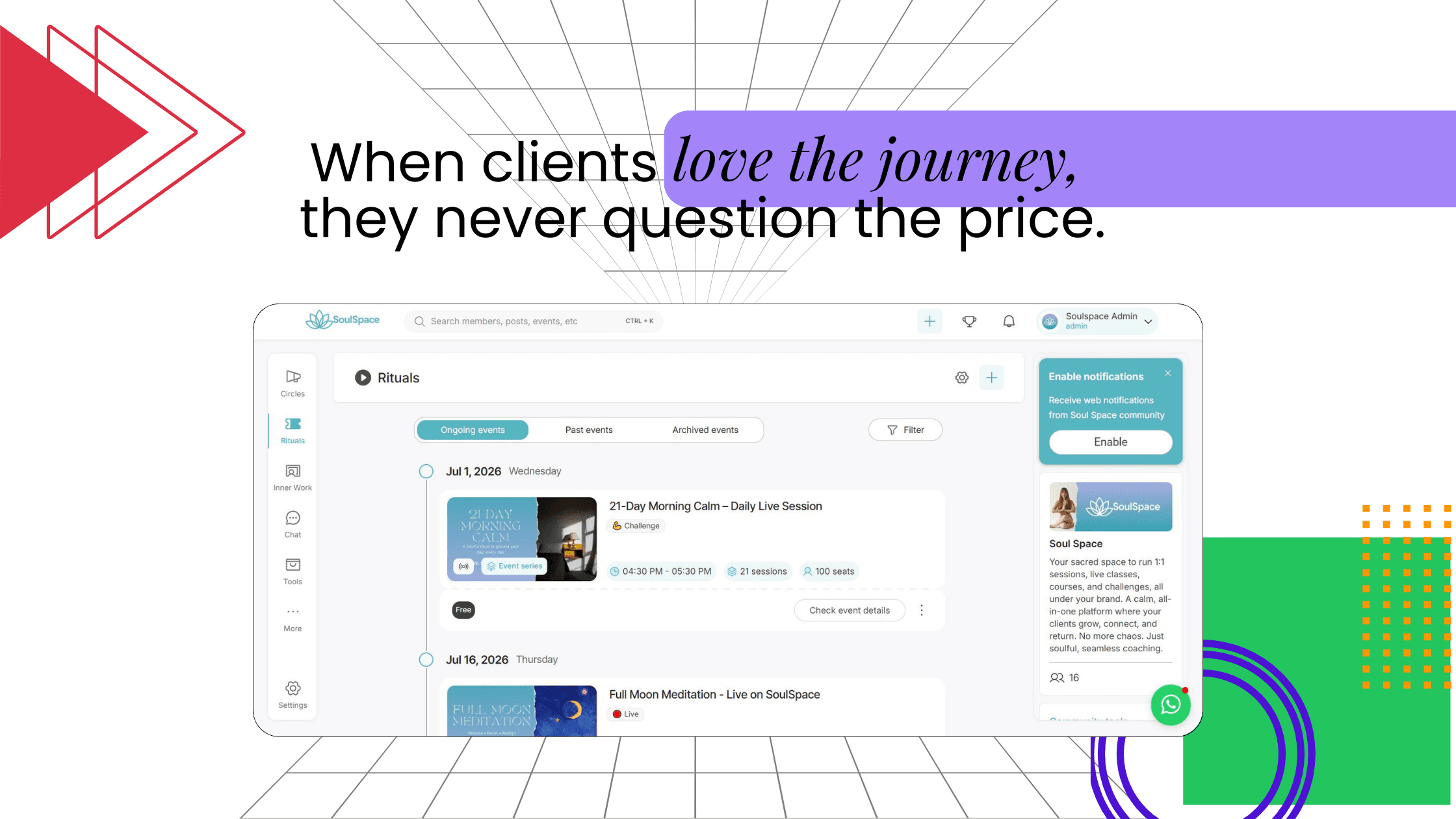
Now that your pricing is aligned, the final step is delivering a coaching experience that supports it. Your clients need one clear place to learn, engage, track progress, stay accountable, and feel guided.
Wylo lets you bring your programs, sessions, community, and resources into one simple, branded hub, without juggling multiple tools.
If you want your coaching to feel structured and professional from Day 1: Start your coaching hub with Wylo for free.

About the Author - Omnath
Founder of Wylo, a highly comprehensive and customizable community platform for coaches, brands, and creators. Omnath helps coaches build structured, scalable, community-driven businesses through simple systems, clear frameworks, and high-quality client experiences.