Community management
Move Clients from WhatsApp to a Coaching Community - Complete Guide
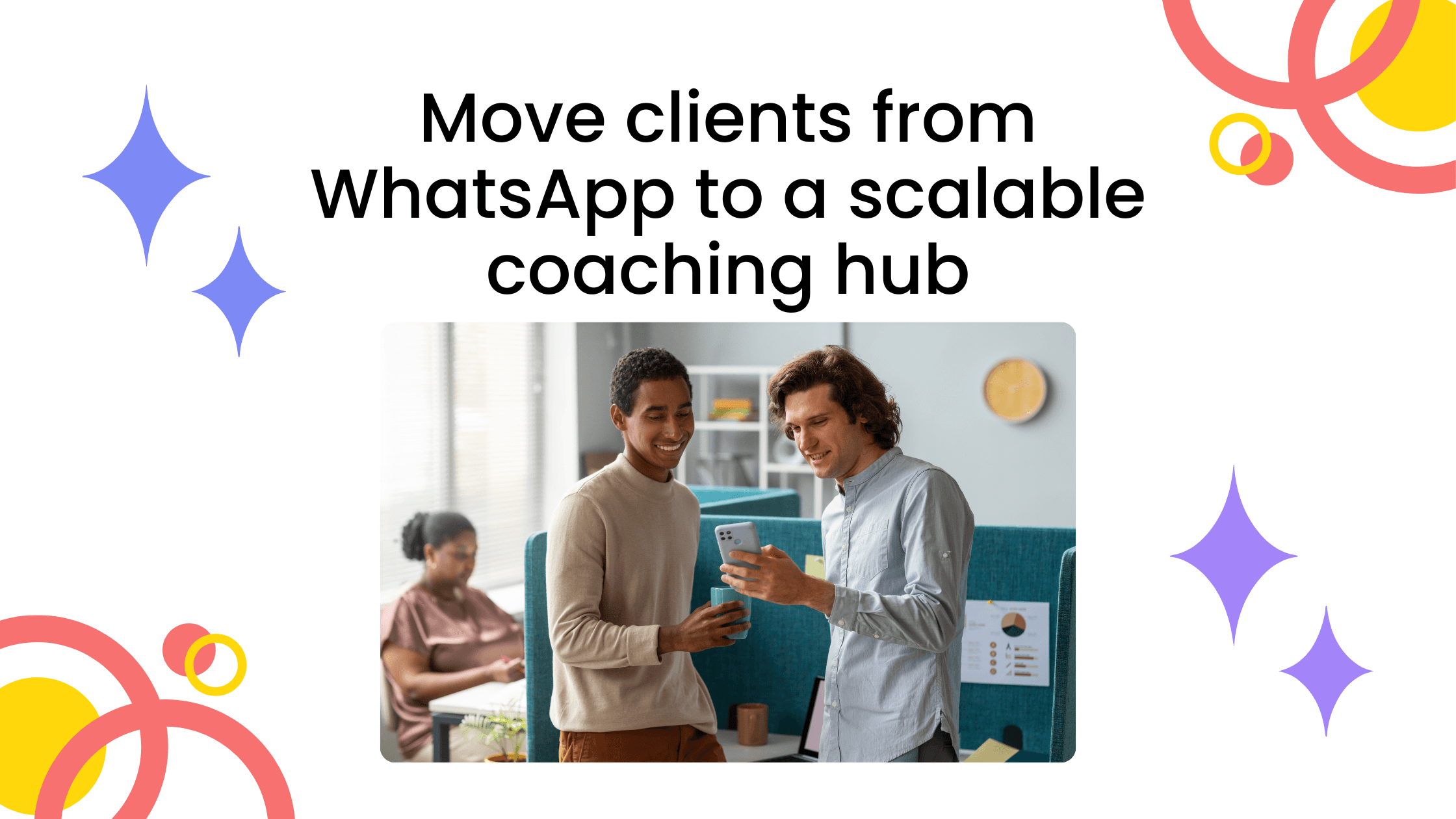
Moving clients from WhatsApp to a coaching community can feel risky, but structuring conversations & progress in one place makes engagement easier. This guide shows how to transition without disrupting your coaching experience.
Contents
Coaches often begin by managing clients on WhatsApp because it feels simple and immediate. Conversations flow easily, updates are quick, and everything seems manageable at first.
But as the coaching business grows, the same system starts to break. Messages get lost in long threads, important discussions become hard to track, and the overall experience begins to feel scattered, hurting engagement and participation.
This is where many coaches start exploring how to move from a group WhatsApp to a coaching community. The issue is rarely the tool itself. WhatsApp works well for communication, but it does not provide structure for a growing coaching business. Without that structure, engagement becomes inconsistent and difficult to sustain.
Moving clients from WhatsApp to a coaching community means shifting from scattered conversations to a structured environment where discussions, progress, and engagement are organized.
A well-designed coaching community platform does not replace communication. It improves how it happens by bringing everything into one place with clarity. If you're still evaluating whether this shift makes sense, it helps to first understand why and how to move your coaching business to a branded community and what changes when you adopt a more structured approach.
In the sections below, we’ll break down why WhatsApp stops working, what a better coaching system looks like, and how to make the transition without losing engagement.
TL;DR
Managing clients on WhatsApp works in the early stages, but it becomes messy as conversations grow and messages start getting lost. The real issue is not the tool, but the lack of structure around how coaching happens. A coaching community solves this by organizing discussions, progress, and interactions in one place, making engagement easier to sustain. Moving clients does not require a sudden shift. With the right approach, you can transition gradually, maintain participation, and create a more structured coaching experience without disrupting your workflow.
Why WhatsApp Stops Working for Coaching Businesses
For many coaches, WhatsApp feels like the easiest way to get started. It’s quick, familiar, and requires no setup. But as soon as the number of clients grows, the same simplicity begins to create friction. What once felt efficient starts to feel overwhelming, especially when managing clients on WhatsApp becomes a daily struggle.
Over time, the experience shifts from smooth communication to constant catch-up. Messages get buried, conversations lose context, and the coaching process begins to feel less structured.
Messages Get Lost in Conversations
One of the most common challenges is that WhatsApp messages get lost easily. Conversations move fast, and important updates disappear as new messages come in. There is no clear way to organize discussions or revisit specific topics without scrolling endlessly.
When a client shares progress, asks a question, or receives guidance, that information quickly gets pushed up in the thread. Over time, valuable insights become difficult to retrieve. Knowledge exists, but it is no longer accessible in a meaningful way.
Conversations Lack Structure
As activity increases, the WhatsApp group starts to feel messy. Discussions about different topics happen in the same place, making it harder to follow any single thread of conversation. This is where many coaches begin to feel that their WhatsApp group is messy rather than useful.
Without categories or dedicated spaces, everything blends together. A question about implementation, a resource shared by the coach, and a casual update from a member all appear in the same stream. This lack of structure makes it harder for clients to engage consistently because they are not sure where to focus.
Coaching Feels Fragmented
Another issue is how disconnected the overall experience becomes. Sessions happen on one platform, conversations on another, and resources are often shared elsewhere. Each part of the coaching process exists, but they do not connect.
Clients attend sessions, then return to scattered chats where context is missing. Resources get shared but are not easy to revisit. As a result, coaching starts to feel like separate pieces instead of a continuous journey.
This fragmentation weakens engagement because there is no single place where everything comes together.
Scaling Becomes Difficult
What works for a small group quickly becomes difficult to manage as the number of clients increases. More messages, more conversations, and more updates create a level of noise that is hard to control.
Without a system to organize interactions, growth leads to confusion. Coaches spend more time managing conversations than actually coaching. Clients, in turn, find it harder to stay engaged because the environment does not support clarity.
At this stage, the challenge is no longer communication. It is the absence of structure.
Coaching Community vs WhatsApp - What Actually Changes

When comparing a coaching community vs WhatsApp, the difference is not just about features. It’s about how the entire coaching experience is structured. At a surface level, both allow communication. But the way that communication happens and what it leads to is very different.
The shift from WhatsApp vs a coaching platform is not about replacing messages. It’s about turning scattered interactions into a connected system where discussions, progress, and participation are easier to manage.
Here’s what actually changes when you move from WhatsApp to a coaching community:
Coaching Community | |
Messages get lost in long threads | Structured discussions that are easy to follow |
No clear organization | Topic-based spaces for focused conversations |
Passive reading of messages | Active participation through guided interactions |
No visibility into progress | Shared progress across members |
What This Shift Means for Your Coaching Business
The real change is not technical. It is behavioral.
In WhatsApp, clients mostly read and respond when something catches their attention. Participation is irregular, and important conversations fade quickly. Engagement depends on constant activity rather than a clear system.
In a coaching community, participation becomes more intentional. Clients know where to share updates, where to ask questions, and how to follow discussions. Progress becomes visible, which encourages others to contribute as well.
This shift creates consistency. Instead of reacting to messages, clients begin to engage with the coaching process itself. Over time, this leads to stronger interaction, clearer communication, and a more structured experience for both the coach and the members.
What Replaces WhatsApp - The Coaching Community System

When coaches move away from WhatsApp, the goal is not simply to adopt another tool. It is to replace a fragmented setup with a system that supports how coaching actually happens. A coaching community platform brings conversations, content, and interactions into one place, but what makes it effective is not the platform itself. It is how the experience is structured inside it.
An online community for coaches works best when it is designed around participation, not just communication. Instead of messages flowing endlessly, interactions are organized in a way that helps clients stay engaged, track progress, and connect with others consistently.
The 3-Layer Coaching Community System
A strong coaching community is built on three layers that work together to create a stable and engaging environment.
Structure: This is where conversations live. Instead of one continuous chat, the community is divided into clear spaces based on purpose. There might be a place for discussions, another for progress updates, and another for resources. This clarity makes it easier for clients to know where to go and how to participate.
Participation: This is what keeps the community active. Rather than relying on spontaneous messages, interaction is guided through simple rhythms. Clients share updates, reflect on their progress, and engage in discussions that connect to their coaching journey. These patterns make participation predictable and easier to sustain.
Visibility: This is what reinforces momentum. When clients can see others sharing progress, implementing ideas, and moving forward, the community feels active. Progress becomes visible, which encourages more participation and creates a sense of shared movement.
Together, these three layers turn a coaching community into more than just a communication space. They create an environment where structure supports interaction, participation builds consistency, and visibility strengthens engagement over time.
How to Move Clients from WhatsApp to a Coaching Community

For most coaches, the biggest challenge is not understanding the benefits of a community. It is figuring out how to move clients from WhatsApp to a coaching community without disrupting engagement. The concern is valid. If clients are comfortable in one place, introducing a new environment can feel like friction.
The key is not to force a complete switch. Moving from WhatsApp to a community works best when the transition feels like a natural improvement rather than a sudden change. When done this way, engagement does not drop. It becomes easier to sustain.
Step 1 - Start with One Use Case
The most effective way to begin is to avoid moving everything at once. Trying to shift all conversations, resources, and interactions immediately can overwhelm clients and reduce participation.
Instead, start with one clear use case. This could be weekly progress updates, post-session reflections, or a focused discussion space. When clients experience how this one element becomes easier to follow and engage with inside the community, they begin to see its value.
Starting small creates clarity. It allows clients to adapt without feeling like they need to change everything at once.
Step 2 - Introduce the Community Gradually
Once the initial use case is established, the next step is to expand gradually. Introduce more interactions into the community while maintaining familiar channels in parallel.
This approach reduces resistance. Clients are not asked to abandon WhatsApp immediately. Instead, they begin using the community for specific activities, which slowly become part of their routine. Over time, the new space feels more natural because it is already integrated into their workflow.
Gradual adoption builds familiarity. It allows behavior to shift without creating friction.
Step 3 - Guide the First Interaction
The first interaction inside the community is critical. If clients join but are unsure what to do, they are likely to observe silently and disengage.
Make the first step clear and easy. Invite them to introduce themselves, share a recent update, or respond to a simple prompt related to their coaching journey. When the action is obvious, participation begins immediately.
Early interaction creates momentum. Once clients engage, they are far more likely to return and continue participating.
This is where understanding how to onboard new clients into a coaching community without friction becomes essential, as it directly shapes early participation and long-term retention.
Step 4 - Keep WhatsApp as a Bridge
A common mistake is trying to eliminate WhatsApp too quickly. This often creates resistance because clients lose a familiar space before they are comfortable in the new one.
Instead, use WhatsApp as a bridge. Continue using it for reminders or quick updates while directing meaningful conversations into the community. For example, you can share a prompt in WhatsApp and ask clients to respond inside the community.
This approach redirects behavior without forcing it. Over time, as clients experience the benefits of structured interaction, their reliance on WhatsApp naturally decreases.
Over time, simple automation can help guide participation without constant manual effort, making it important to understand how to automate client engagement in a coaching community in a way that keeps interactions consistent and scalable.
Step 5 - Shift Conversations Slowly
As participation grows inside the community, begin shifting more discussions into it. Move key conversations, updates, and interactions into structured spaces where they are easier to follow and revisit.
Reinforce this shift by consistently responding inside the community and encouraging others to do the same. When clients see that meaningful conversations happen there, they begin to return more often.
This gradual transition ensures that engagement is maintained throughout the process. Instead of losing participation during the move, you create a stronger and more structured environment that supports it.
If you’re also managing a Facebook group, the transition process has its own nuances. In that case, it's important to know how to move your Facebook group to a coaching community step by step.

How to Move Without Losing Engagement

One of the biggest concerns when you move a coaching business to a community is whether engagement will drop during the transition. Clients are used to WhatsApp. It feels immediate, familiar, and easy. Introducing a new space can feel like adding friction.
In practice, engagement only drops when the transition is handled abruptly. When the shift is guided properly, participation often improves because the environment becomes clearer and easier to engage with.
Don’t Force the Switch
A forced transition usually leads to silence. When clients are suddenly asked to stop using WhatsApp and move everything into a new platform, they hesitate. The change feels disruptive, even if the new system is better.
Engagement depends on comfort. If clients feel unsure about where to go or what to do, they are more likely to disengage temporarily. Instead of forcing the switch, allow behavior to shift gradually. Let clients experience the new environment before expecting full adoption.
Show Value Before Migration
Clients do not adopt new systems because they are told to. They adopt them when they see clear value. Explaining why a community is better is helpful, but experience matters more than explanation.
When clients interact inside a structured space, where discussions are easier to follow and progress is visible, they understand the difference immediately. That experience builds trust in the new system and reduces resistance to moving more interactions there.
Make Participation Easy
Early participation should feel effortless. If joining the community requires too many steps or if the first action is unclear, clients are likely to delay engaging.
A simple prompt can make a significant difference. Asking members to introduce themselves, share a small update, or respond to a question removes hesitation. When the path to participation is clear, engagement starts naturally.
Reducing friction at the beginning increases the likelihood of consistent involvement later.
Build Early Momentum
The first few days inside a community shape how it feels long term. When early activity is visible, members recognize that the space is active and worth returning to.
This momentum does not need to come from volume. A few meaningful interactions, thoughtful responses, and visible progress updates are enough to create movement. Once members see others participating, they are more likely to contribute themselves.
Early engagement sets the tone. When clients experience the community as active and supportive from the start, participation becomes easier to sustain over time.
Common Mistakes When Moving from WhatsApp
Many of the problems with WhatsApp groups for business don’t disappear automatically when you switch tools. They often carry over if the transition is not handled thoughtfully. The issue is not just where conversations happen, but how the new environment is introduced and used.
Avoiding a few common mistakes can make the difference between a smooth transition and a drop in engagement.
Moving Everything at Once
One of the most common mistakes is trying to move all interactions out of WhatsApp immediately. While the intention is to create a clean shift, this approach often overwhelms clients.
When everything changes at once, members need to relearn where to find information, how to communicate, and how to participate. This creates hesitation, and participation can slow down during the transition.
A gradual shift works better. When clients are introduced to one part of the community at a time, they adapt more easily and begin to engage without friction.
Not Guiding Members
Another common issue is assuming that clients will naturally understand how to use the new space. In reality, most people need clear direction when they enter a new environment.
If members are not guided toward their first interaction, they tend to observe silently. Without prompts or clear next steps, participation feels uncertain, and engagement becomes inconsistent.
Guidance creates momentum. When clients know exactly what to do first, they are more likely to engage and continue participating.
Choosing the Wrong Platform
Not all platforms are designed for coaching communities. Some tools support communication but lack the structure needed for discussions, progress tracking, and engagement.
If the platform does not support organized conversations, events, content, courses, and clear spaces for interaction, the experience may feel similar to WhatsApp, just in a different interface.
The right platform should simplify the coaching process, not replicate the same limitations in a new form.
Ignoring Engagement Systems
Moving to a new platform without designing how people will participate often leads to the same outcome as before. Conversations become irregular, and activity depends on individual effort rather than a shared rhythm.
Engagement systems, such as regular updates, reflection prompts, or structured discussions, help create consistency. Without them, the community remains passive even if the platform is well designed.
A successful transition is not just about moving conversations. It is about creating an environment where participation becomes easier to sustain.
Tools to Manage Coaching Clients Beyond WhatsApp
As coaching businesses grow, the need for better tools to manage coaching clients becomes more visible. WhatsApp works for quick communication, but it does not provide a structured environment for ongoing coaching. This is where a coaching community platform becomes useful, not as a replacement for messaging, but as a system that brings everything together.
Instead of managing conversations, content, and sessions across different tools, a centralized platform allows all interactions to happen in one place. Discussions are organized, so clients can follow and contribute without confusion. Events bring members together for live interaction, creating shared experiences that strengthen engagement. Content, such as resources and session recordings, remains accessible and easy to revisit when needed.
This kind of setup reduces fragmentation. As a coach, you spend less time managing scattered tools and more time focusing on actual coaching. Clients, in turn, experience a clearer journey where conversations, learning, and progress are connected.
The goal is not to add another tool to your workflow. It is to create a system where communication, participation, and progress align naturally within a single environment.
If you want a complete step-by-step roadmap, this 30-day checklist to launch a coaching community will help you implement this transition effectively.
FAQs About Moving From WhatsApp to a Coaching Community
How to move clients from WhatsApp to a coaching community?
The most effective way to move clients from WhatsApp to a coaching community is to start gradually. Begin with one clear use case, such as progress updates or discussions or events, and guide clients toward participating there. Keep WhatsApp as a bridge initially while shifting meaningful interactions into the community. Over time, as clients experience the value of structured conversations, adoption becomes natural.
Why is WhatsApp not good for coaching businesses?
WhatsApp is useful for communication but not designed for structured coaching. Messages get lost in long threads, discussions lack organization, and progress is difficult to track. As coaching businesses grow, these limitations make it harder to maintain clarity and engagement across clients.
What is better than WhatsApp for coaching clients?
A coaching community platform is often more effective because it organizes discussions, events, and content in one place. Instead of scattered conversations, clients interact in structured spaces where they can share progress, follow discussions, and stay engaged between sessions.
Can I use both WhatsApp and a community platform?
Yes, and in many cases, this works best during the transition. WhatsApp can be used for reminders or quick communication, while the community becomes the main space for discussions and engagement. Over time, as clients become comfortable, most interactions naturally move into the community. In specific scenarios, they both can be used simultaneously.
Final Takeaway - Don’t Replace WhatsApp, Replace the System
Many coaches assume the problem is the tool. In reality, the challenge is the lack of structure around how coaching happens.
WhatsApp is not the problem. Lack of structure is.
Conversations alone do not create engagement. Systems do. When coaching relies only on messages, participation becomes inconsistent. But when interactions are organized within a structured environment, engagement becomes easier to sustain.
Coaching sessions create insight. Communities sustain progress. Structure creates consistency.
If you want to move your coaching clients from WhatsApp into a structured, scalable environment, the focus should not be on switching tools but on building a system that supports participation and progress in one place.
Want to build a holistic and flexible coaching community? Check out Wylo. Want to start a free trial?

About the Author – Senthil
Marketing Head of Wylo, a highly comprehensive and customizable community platform for coaches, brands, and creators. Senthil helps coaches design clear marketing systems, strong positioning, and sustainable monetization models through practical community frameworks and execution-first strategy.