Coaching community
How to Host Cohort-Based Courses That Drive Real Client Transformation for Coaches
Cohort-based courses fail when they're treated like upgraded self-paced programs. This guide breaks down how to design a time-bound, accountability-driven coaching cohort that creates genuine client transformation, not just attendance.
Contents
If you’re figuring out how to host cohort-based courses for your clients as a coach, this guide is about execution, not theory or hype.
Many cohort programs appear promising on the surface, with weekly calls, shared timelines, and group access, but still fail to create real transformation.
That usually happens because they’re treated like upgraded courses instead of what they actually are: structured, time-bound cohort-based coaching systems designed to drive behavior change through accountability, cadence, and peer interaction.
Most coaches don’t struggle with what to teach inside a cohort. They struggle with why the cohort doesn’t work.
Common symptoms look like this: your clients attend live calls but don’t follow through between sessions, and engagement drops after week 2. You carry all the energy while participants stay passive; outcomes still look no better than a self-paced course.
The mistake is assuming that adding live calls automatically makes something cohort-based. It doesn’t.
A true cohort is not a content format. It’s a guided transformation system. The value doesn’t come from how many lessons you release or how polished the curriculum is. It comes from how well the cohort:
creates commitment over a fixed timeline
enforces participation rhythms
uses peer visibility to drive accountability
moves clients from intention to consistent action
When cohorts fail, it’s rarely because the material was weak. It’s because the system didn’t support behavior change between sessions and course touch points.
This guide reframes how to run cohort-based courses as a coach, focusing on structure, cadence, and participation design, not just live delivery. If you want the broader context of how cohorts fit into a scalable coaching model, this connects directly with the system explained in How to Grow Your Coaching Business with Online Communities.
TL;DR - What Actually Makes Cohort-Based Courses Work
Cohort-based courses work because they create accountability, not more content
A cohort is a time-bound transformation system, not a lesson library
Structure, cadence, and peer interaction matter more than curriculum depth
Cohorts outperform self-paced courses when participation is designed in
The real leverage comes from what happens between sessions, not during them
If your cohort feels busy but clients aren’t changing, the issue isn’t effort. It’s structure.
What Is a Cohort-Based Course (For Coaches)?
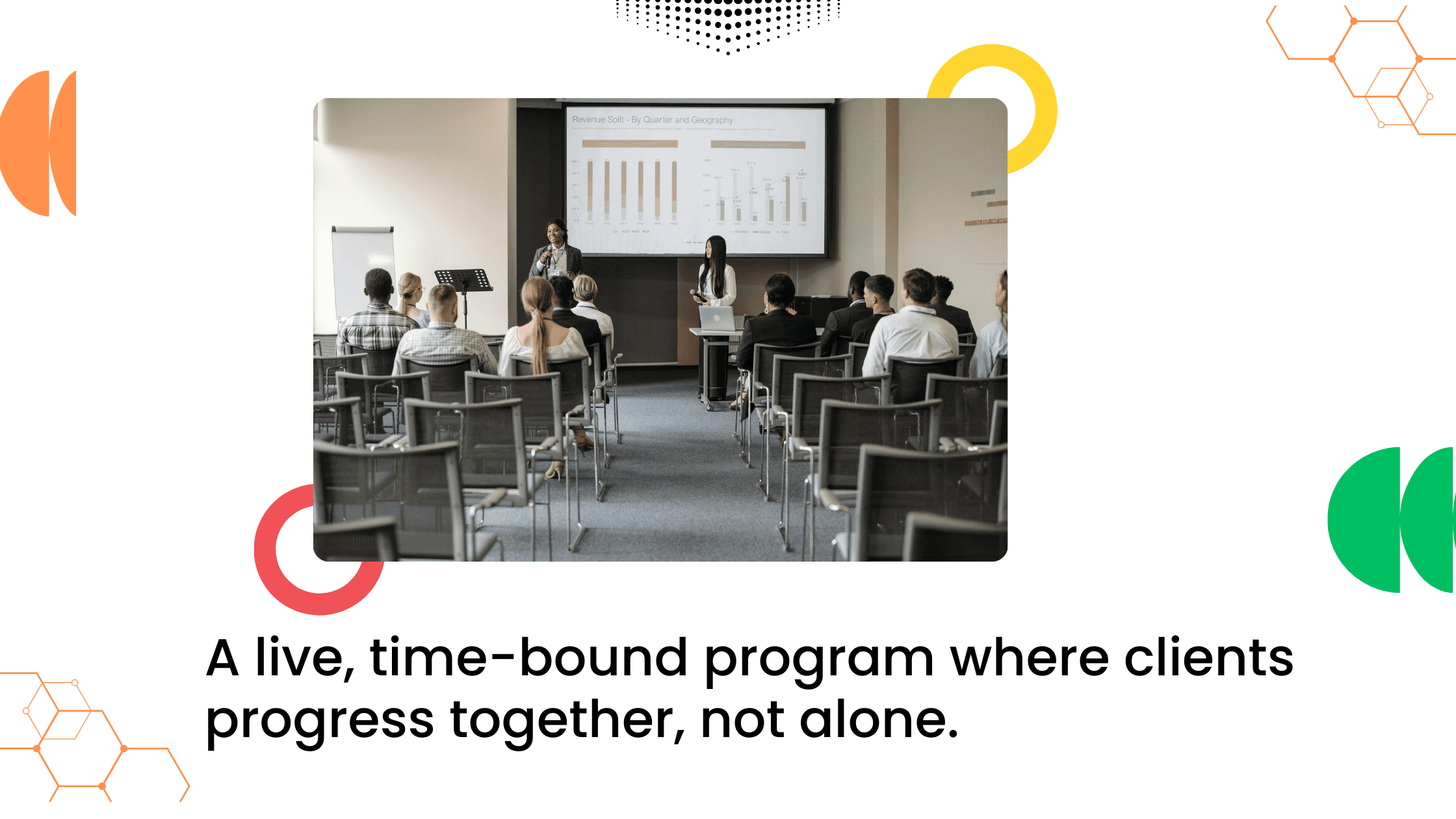
A cohort-based course is a time-bound, group-led learning experience where clients move through a structured transformation together, on the same timeline, with shared milestones and visible participation.
At its core, a cohort-based course has four non-negotiables:
Time-bound: A clear start and end date
Group-led: Clients move together, not at their own pace
Outcome-driven: Designed around a specific, shared result
Participation-based: Progress is visible, not private
If any of these are missing, you don’t have a cohort. You have a course with optional group calls.
This is why many cohort based coaching programs outperform self-paced formats: they reduce ambiguity and force momentum through structure, not motivation.
How Cohort-Based Learning Differs from “Group Calls + Content”
A common mistake coaches make is assuming that adding weekly Zoom calls turns a course into a cohort. It doesn’t.
Here’s the difference:
Group calls + content
Clients consume lessons privately
Live calls are reactive and unstructured
Progress varies widely across participants
Engagement depends heavily on coach's energy
Cohort-based learning
Everyone follows the same timeline
Sessions reinforce a shared stage of progress
Participation is expected and visible
Peer interaction drives accountability
In a cohort, the group becomes part of the system. Clients don’t just learn from the coach; they learn from seeing others apply, struggle, and progress in real time.
Why Coaches Use Cohorts for Results
While cohorts can be more scalable than 1:1 coaching, that’s not the primary reason they work.
Coaches use cohort-based courses because they:
increase follow-through between sessions
reduce drop-off through shared momentum
surface blind spots faster via peer discussion
create stronger client outcomes in less time
The real leverage isn’t the number of people in the cohort. It’s the behavioral shift created by moving together.
When clients know others are showing up, sharing progress, and applying the work, participation becomes the default. That’s what turns a curriculum into a transformation system, and why well-designed cohort-based coaching programs consistently outperform content-first formats.
Why Cohort-Based Courses Work Better for Client Transformation
Most coaches don’t struggle with what to teach. They struggle with clients not applying their teachings consistently. This is exactly where cohort-based formats outperform self-paced courses and loose group programs.
Cohort-based programs for client transformation work because they change behavior through a solid yet flexible structure. The system itself creates momentum, accountability, and follow-through, without you needing to push every step.
Accountability Is Built Into the System
In cohort-based coaching, accountability isn’t an add-on. It’s embedded into how the program runs.
Three structural elements make this work:
Fixed timelines: Everyone moves through the same phase at the same time. There’s no “I’ll catch up later,” which is where most clients stall.
Shared progress: Clients know others are working on the same challenge this week. That shared context removes hesitation and normalizes effort.
Social visibility: Progress, questions, and reflections are seen by the group. When effort is visible, follow-through increases naturally.
Because accountability is systemic, not personal, your clients don’t rely on reminders or pressure from you. The structure does most of the work.
Peer Learning Multiplies Impact
Clients don’t just learn from instruction. They learn faster from context. In cohort-based environments:
Clients hear how others are applying the same idea in real situations
Struggles surface earlier and feel less isolating
Insights land deeper because they’re tied to real-world experience
This is why group reflection accelerates breakthroughs. When a client hears someone articulate a challenge they couldn’t yet name, clarity happens instantly. When they see a peer apply a concept successfully, their belief in it increases.
Cohort learning replaces abstract theory with real-time examples. That’s what turns understanding into action.
Cohorts Increase Completion and Retention
One of the most overlooked advantages of cohort formats is follow-through.
Self-paced courses fail not because the content is weak, but because there’s no external structure to sustain effort. Cohorts solve this by making participation part of the experience.
Cohort-based programs consistently show:
higher completion rates due to time-bound structure
stronger engagement between sessions
deeper relationships formed during the journey
This directly impacts cohort-based learning retention. Clients who finish strong and experience visible progress are far more likely to:
trust the coach long-term
continue into advanced programs or memberships
refer others with confidence
Transformation builds trust. Trust builds retention. Cohorts close that loop by design.
This is why cohort-based courses don’t just deliver better short-term results; they create lasting client relationships that extend well beyond the program itself.
Cohort-Based Courses vs Self-Paced Courses (What Coaches Should Choose)
Most coaches eventually face this decision: should you package your expertise into a self-paced course, or run a live cohort-based program? The answer depends less on scale and more on the type of outcome you want clients to achieve.
This comparison between cohort-based courses vs self-paced formats isn’t about which is “better” in general. It’s about choosing the right system for the result you’re responsible for delivering.
When Self-Paced Courses Make Sense
Self-paced courses work best when the primary goal is knowledge transfer, not behavior change.
They make sense when:
The outcome is informational (learning a framework, tool, or concept)
Clients can progress independently without feedback loops
There’s no urgency tied to the application or the results
You’re offering an entry-level product or orientation layer
In these cases, flexibility is an advantage. Learners can move at their own pace, revisit material, and consume content when it fits their schedule.
However, self-paced formats rely heavily on self-motivation. For clients who already struggle with consistency, this often leads to low completion and limited real-world application.
When Cohort-Based Coaching Wins
Cohort-based coaching is the stronger choice when the outcome requires behavior change, identity shifts, or sustained effort.
Cohorts outperform self-paced courses when:
Clients need accountability to follow through
Progress depends on applying concepts over time
Reflection, feedback, and iteration matter
The transformation is experiential, not theoretical
In cohort-based programs, momentum is shared. Clients don’t just learn what to do, they see others doing it alongside them. That shared effort reduces friction and normalizes action.
This is why coaches focused on transformation, not just education, consistently choose cohorts. The structure supports outcomes that self-paced formats struggle to deliver.
The Hybrid Model (Common Mistake Explained)
Many coaches attempt a hybrid approach: self-paced content plus occasional live calls. On paper, it sounds like the best of both worlds. In practice, it often fails.
Here’s why “self-paced + live calls” breaks down:
Content consumption and live sessions aren’t structurally connected
Clients fall behind on lessons, then feel unprepared for calls
Live sessions turn into lectures instead of interaction
Accountability remains optional, not systemic
This is where cohort-based learning vs membership confusion often appears. Coaches unintentionally create a loose membership with sporadic events instead of a true cohort.
A real cohort isn’t defined by having live calls. It’s defined by:
a shared timeline
synchronized progress
participation that’s expected, not optional
When those elements are missing, the hybrid model becomes passive. Clients drift. Engagement drops. And the coach ends up compensating with more effort instead of a better structure.
How to Decide The Best Course Model as a Coach
Choose self-paced when your responsibility ends at understanding. Choose cohort-based when your responsibility includes outcomes.
If clients need to do, not just know, cohort-based courses are the clearer, more reliable path.
The Cohort Coaching Model (Core Differentiator)
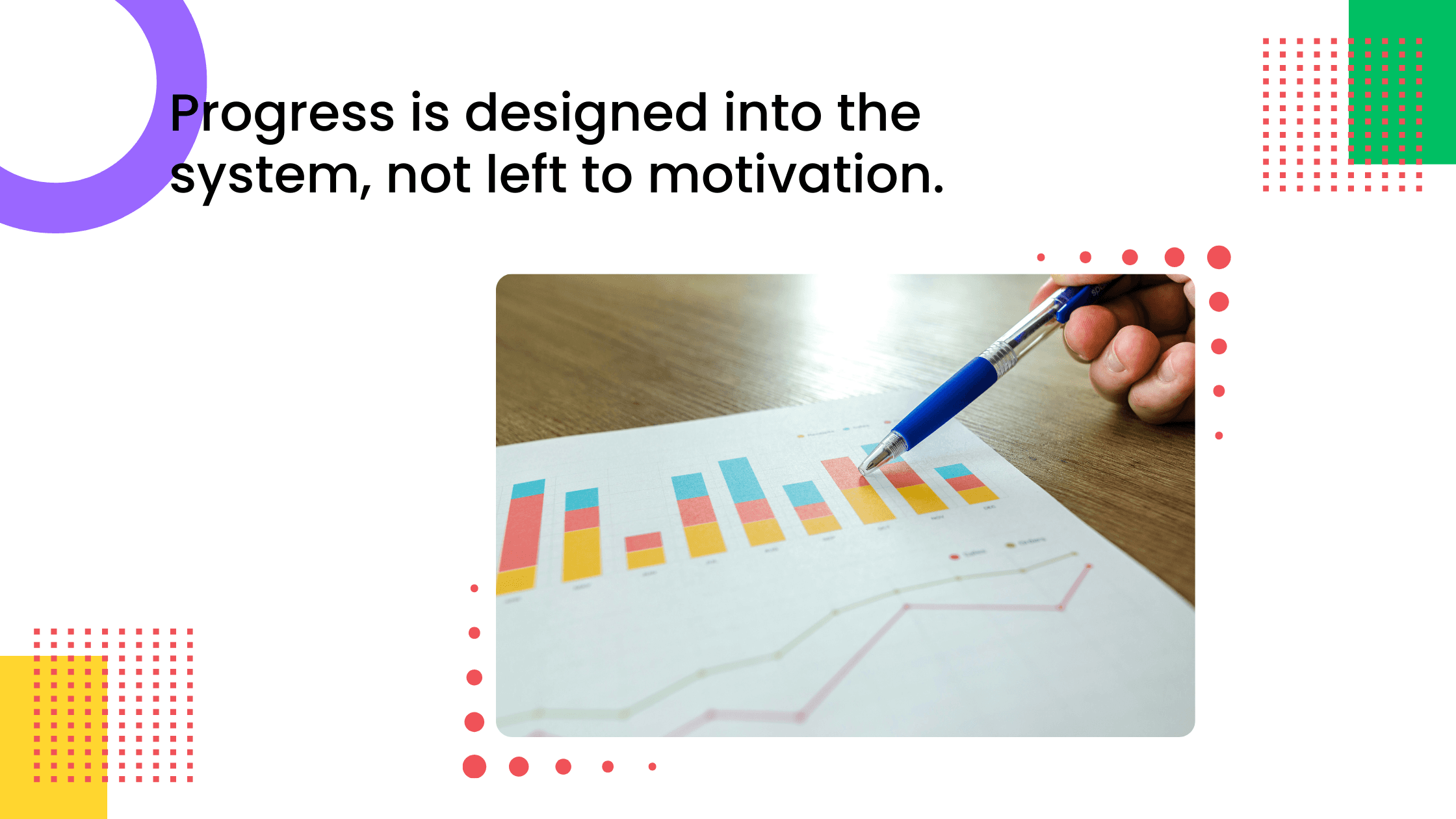
Most cohort-based programs fail because they’re treated as courses with live calls. High-performing cohorts work because they follow a cohort coaching model, a structured system that drives commitment, progress, and accountability over time.
This section breaks down that model end to end. Not as a list of features, but as a sequence of phases that explain why cohort-based group coaching works when it’s designed intentionally.
Phase 1 - Enrollment & Commitment
Cohorts succeed or fail before Week 1 even begins. Enrollment is not just about filling seats. It’s about creating commitment to a shared outcome and a shared way of working.
This phase must clarify three things upfront:
Who the cohort is for
Participants should instantly recognize themselves. A well-defined cohort attracts fewer people but creates far stronger alignment. When the group is too broad, accountability weakens because members can’t relate to each other’s context.
The outcome they’re committing to
A cohort needs a clear transformation, not a vague promise. “Get better at X” doesn’t create urgency. “By the end of 6 weeks, you’ll have done Y” does. Outcomes anchor effort and give the cohort a reason to stay engaged when motivation dips.
What participation actually requires
Cohorts break when participation is optional. Before the program starts, members should know:
how often they’re expected to show up
what they’ll be asked to share
and what “engaged” looks like in practice
Clear expectations turn enrollment into a commitment, not just a purchase.
Phase 2 - Guided Weekly Progress
In effective cohort based group coaching, live sessions are not content delivery. They’re checkpoints.
Each week should revolve around:
one core action
one clear focus
one visible form of progress
Why this works:
Fewer actions reduce overwhelm
Weekly rhythm creates momentum
Progress becomes observable, not theoretical
Live sessions exist to:
review what happened
unblock stuck participants
recalibrate the group’s direction
When sessions turn into lectures, cohorts lose their power. When they’re used as progress reviews, participants stay engaged because the work matters between sessions, not just during them.
Phase 3 - Peer Accountability Loop
The defining feature of a strong cohort coaching model is peer accountability. Transformation accelerates when progress is:
shared publicly
reflected on together
and normalized through group discussion
This phase works best when:
participants reflect in small groups
progress updates are visible to peers
and feedback comes from multiple perspectives
The coach’s role shifts here. Instead of rescuing individuals, the coach facilitates the system:
highlighting patterns
reinforcing good behavior
and redirecting the group when momentum slips
When peers hold each other accountable, outcomes no longer depend on the coach’s constant intervention. The cohort starts doing the work itself.
Phase 4 - Transition, Not End
Most cohorts fail at the finish line. Programs end. Calls stop. Engagement drops. Participants are left asking, “What now?” High-performing cohorts don’t end. They transition.
This phase answers:
where progress continues
how relationships persist
and what the next commitment looks like
Common transitions include:
moving into an ongoing community
continuing accountability in a lighter format
or advancing into a deeper program.
The goal is not to sell aggressively. It’s to preserve momentum. When participants know where their progress goes next, the cohort’s value extends far beyond its timeline.
Why This Model Works
This cohort coaching model succeeds because it aligns structure with behavior:
commitment before content
progress before learning
peers before pressure
and continuity before completion
That’s what separates transformational cohort based group coaching from programs that feel busy but don’t change outcomes.
When cohorts are designed as systems, not schedules, they become one of the most reliable ways for coaches to deliver results while reducing long-term delivery load.

How to Host a Cohort-Based Course Step by Step
If you’re searching for how to host cohort-based courses, what you usually find are tools, templates, or launch checklists. What actually determines whether a cohort works is structure. This section breaks down how to run cohort based programs in a way that drives participation and client results, without increasing burnout or delivery load.
This is execution clarity, not platform setup.
Step 1 - Define the Transformation Window
Every strong cohort starts with a clear transformation window.
Length: 4-8 weeks is the sweet spot
Shorter than four weeks doesn’t allow habits to form. Longer than eight weeks increases drop-off and fatigue. Most high-performing cohort based courses sit comfortably in this range because it balances urgency with sustainability.
One core outcome, not many
Cohorts fail when they try to solve everything at once. A cohort should focus on one meaningful shift:
one behavior change,l
one system implemented
one identity shift unlocked
Clarity here simplifies everything that follows: session design, weekly actions, and accountability. When participants know exactly what they’re working toward, effort becomes focused instead of scattered.
Step 2 - Design the Weekly Rhythm
Cohorts don’t work because of content volume. They work because of rhythm. Each week should follow a predictable pattern:
Live session purpose
The live session is a checkpoint, not a lecture. Its role is to:
review progress from the previous week
address common blockers
align the group around the next action
When live sessions are treated as progress reviews, attendance stays high because showing up matters.
Async reflection
Between sessions, participants need space to reflect and share publicly. This is where learning deepens. Reflection turns experience into insight and keeps momentum alive when there’s no call.
Peer touchpoints
Weekly peer interaction reinforces accountability. Small-group check-ins or shared reflection threads help participants realize they’re not alone, which dramatically reduces drop-off.
Consistency beats novelty here. When the rhythm is predictable, participation becomes habitual.
Step 3 - Structure Live Sessions for Participation
One of the biggest mistakes in cohort based programs is turning live sessions into long teaching blocks. High-performing cohorts design sessions around interaction:
No long teaching blocks
If the coach talks for most of the session, participants disengage. Teaching should be concise and purpose-driven, only enough to support the week’s action.
Prompt-led discussion
Sessions should revolve around prompts:
What did you try?
What worked?
Where did you get stuck?
What are you committing to next?
Prompts shift the session from delivery to dialogue.
Public learning
When participants share experiences live, everyone learns from one moment. This is where cohorts outperform self-paced formats. One person’s challenge becomes collective insight.
Live sessions succeed when participants leave feeling involved, not informed.
If live sessions are a core part of your cohort, their effectiveness depends on how intentionally they are designed. Knowing how to host events and sessions for your coaching community in a way that prioritizes interaction over passive attendance ensures that sessions drive accountability, peer exchange, and measurable progress rather than becoming one-way broadcasts.
Step 4 - Design Accountability Without Burnout
Most coaches try to create accountability with reminders, check-ins, and follow-ups. That doesn’t scale.
Why reminders don’t work
Reminders rely on motivation or forced activation. Motivation fluctuates. When accountability depends on the coach chasing people, burnout follows and participation drops anyway.
How structure replaces motivation
In strong cohort-based courses, accountability is built into the system:
actions are simple and visible
progress is shared publicly
peers notice absence before the coach does
When participation is expected and visible, accountability becomes social, not enforced. Your role shifts from policing behavior to reinforcing momentum.
This is the difference between cohorts that drain energy and cohorts that run smoothly. Structure does the most of the work so you don't have to.
When you break down how to run cohort based programs this way, the process becomes simpler than most coaches expect. You’re not managing people. You’re designing an environment where progress, accountability, and momentum happen naturally.
That’s what turns a cohort from a stressful launch into a repeatable transformation system.
Common Mistakes Coaches Make With Cohort-Based Courses
Cohort-based courses fail less because of bad ideas and more because of predictable design mistakes. Coaches often bring habits from self-paced courses or 1:1 coaching into cohorts, and those habits quietly break participation, accountability, and outcomes.
Below are the most common mistakes coaches make with cohort based courses, and why each one limits results even when the content itself is strong.
Over-Teaching Instead of Facilitating
One of the biggest mistakes in cohort based coaching programs is treating live sessions like classrooms.
When the coach:
talks for most of the session
delivers long explanations
tries to “cover” all the material
participants slip into passive mode. They listen, take notes, and wait for direction instead of acting. Cohorts work because they are interactive systems, not lecture series. Your role as a coach is to:
surface patterns
ask the right questions
guide reflection
help participants connect insights to action
Facilitation creates transformation. Over-teaching creates information overload and low ownership.
Treating Attendance as Success
Another common mistake is measuring success by people showing up.
High attendance feels reassuring, but attendance alone doesn’t indicate progress. A cohort can have full sessions and still deliver weak outcomes if participants:
aren’t applying what’s discussed
don’t share progress publicly
leave sessions unchanged
In strong cohort based courses, success is measured by behavior:
Did participants take the weekly action?
Did they reflect or share publicly?
Did progress become visible over time?
When attendance is the goal, sessions turn performative. When participation is the goal, transformation follows.
No Post-Cohort Path
Many cohorts end abruptly. The final session wraps up, the group says goodbye, and momentum collapses overnight. This is one of the most damaging mistakes coaches make.
Cohorts should never end without direction.
Without a post-cohort path:
learning fragments
relationships dissolve
long-term retention disappears
High-performing cohort based coaching programs always answer one question before the final week: What happens next? That “next” might be:
an ongoing community
a membership layer
an advanced cohort
or a structured integration phase
When participants know where progress continues, the cohort becomes a bridge instead of a dead end.
Overloading Clients With Content
More content does not create better outcomes. In cohorts, it usually does the opposite. This mistake shows up as:
long weekly modules
multiple frameworks at once
extra resources
Participants fall behind, feel overwhelmed, and disengage quietly. Effective cohort based courses are designed around:
one core action per week
minimal but essential input
repeated application instead of constant novelty
Transformation comes from doing less, consistently, not from consuming more. All of these mistakes share the same root cause: designing cohorts like courses instead of systems.
When coaches shift their focus from delivery to participation, from content to cadence, and from completion to continuity, cohort-based courses stop feeling heavy and start producing real, repeatable client results.
How Cohort-Based Courses Feed Long-Term Community Growth
Cohort-based courses shouldn’t exist in isolation. When designed well, they become one of the strongest growth systems inside a coaching business, because they change how clients engage long after the cohort ends.
Many coaches use short challenges before or after cohorts to activate participation and reignite momentum. Understanding how to host challenges for a coaching community strategically allows you to use them as activation bridges, increasing visibility, encouraging quick wins, and strengthening commitment before members transition into deeper programs or ongoing engagement layers.
For coaches building communities, cohort learning for coaches works best when it feeds directly into ongoing participation, retention, and deeper commitment.
Cohorts as Activation Engines
Cohorts are one of the most effective ways to activate new members. Instead of dropping people into a community and hoping they “figure it out,” cohorts:
create a shared starting line
teach participation by doing
normalize showing up, sharing, and reflecting
New members don’t just consume content. They practice:
posting progress
responding to peers
engaging publicly
By the time the cohort ends, participation already feels familiar. This warm-up effect is why communities that onboard members through cohorts stay more active than those relying on welcome posts or orientation videos.
Cohorts as Trust Accelerators
Cohorts build trust faster than almost any other format. Compared to 1:1 onboarding, cohorts:
expose clients to the coach repeatedly in real time
show how you think, adapt, and support
create social proof through peer progress
Trust doesn’t form because clients receive answers. It forms because they experience support while taking action. In a cohort, clients see:
others struggling and progressing
feedback applied immediately
outcomes emerging week by week
This shared experience compresses trust-building that might otherwise take months into a few weeks. That’s why cohorts often outperform 1:1 onboarding for long-term commitment to your coaching and community.
Cohorts as Segmentation Signals
Cohorts naturally reveal who is ready for more. Unlike surveys or interest forms, cohorts show true behavior:
who shows up consistently
who applies feedback
who supports others
who completes the work
These signals are invaluable for community growth. They help coaches identify:
members ready for advanced programs
potential ambassadors or moderators
clients who thrive in deeper group environments
Instead of guessing who to invite into higher-level offers, coaches can observe it directly through cohort participation.
When cohort-based courses are designed as part of a broader system, they act as engines for sustainable growth.
They activate new members, accelerate trust, and surface readiness, all while strengthening the community itself. That’s why the real value of cohort learning for coaches isn’t just better course outcomes. It’s building a community that grows stronger with every cohort.
When (and When Not) to Monetize Cohort-Based Programs
Monetization works best in cohort-based programs when it reinforces behavior that already exists. When pricing is introduced too early or for the wrong reason, it adds pressure without improving outcomes. The goal isn’t to simply sell a cohort, but to determine when payment increases commitment, focus, and follow-through.
The top five ways to monetize your coaching community, from structured cohorts and recurring memberships to challenges, events, and hybrid models, only succeed when they align with the natural engagement patterns already present. Pricing should amplify momentum, not compensate for its absence.
This distinction matters for coaches who want sustainable cohort-based programs without eroding trust, retention, or long-term engagement.
Free or Low-Ticket Cohorts (Activation)
Free or low-ticket cohorts work best as activation tools. They are effective when the goal is to:
onboard new clients into your ecosystem
introduce your coaching style and expectations
build participation habits quickly
warm up members for deeper work later
At this stage, pricing should reduce friction, not create it. A free or low-cost cohort lowers the barrier to showing up while still creating enough structure for real engagement. What matters most here isn’t revenue, but behavior:
Are clients attending consistently?
Are they completing weekly actions?
Are they interacting with peers publicly?
If those signals are strong, the cohort has done its job. It has activated people into the system. Monetization can come later, once participation is proven.
Free cohorts fail when they’re treated as giveaways with no structure. Low commitment leads to low outcomes. Even free cohorts must be time-bound, outcome-driven, and participation-focused to work.
Paid Cohort-Based Coaching Programs
Paid cohorts work when payment reinforces commitment, not when it tries to create it. Charging makes sense when:
clients already understand how to participate
the outcome is clear and meaningful
the cohort requires sustained effort over time
peer accountability is central to the experience
In these cases, payment stabilizes behavior. Clients who invest financially are more likely to:
protect time for sessions
complete weekly actions
stay engaged when the work gets uncomfortable
This isn’t because money creates motivation. It’s because it signals intent. Pricing should match the depth of transformation, not the volume of content. High-performing cohort-based coaching programs price around:
access to guidance and feedback
structured accountability
shared progress with peers, not lesson count or hours of video
Paid cohorts struggle when:
engagement habits aren’t established yet
expectations aren’t clearly set
clients don’t know what participation looks like
In those cases, charging raises expectations without providing the structure needed to meet them. The result is frustration, not commitment.
The rule is simple: never monetize a cohort to fix engagement. Monetize to stabilize it.
When participation, structure, and outcomes are already working, pricing reinforces the system. When they aren’t, monetization adds friction. Coaches who get this sequence right build cohort-based programs that feel valuable, effective, and sustainable over time.
FAQs About Cohort-based Courses For Coaches
What is a cohort-based course in coaching?
A cohort-based course in coaching is a time-bound, group-led program where clients move through the same transformation together. Unlike self-paced courses, cohorts are designed around participation: live checkpoints, shared progress, and peer accountability. The focus isn’t content consumption, but guided behavior change over a fixed period.
How long should a cohort-based program run?
Most effective cohort-based programs run 4 to 8 weeks. This window is long enough to create momentum and meaningful change, but short enough to maintain urgency and commitment. Longer cohorts tend to lose energy unless they’re broken into clear phases with visible progress markers.
Are cohort-based courses better than self-paced, for coaches?
For client transformation, yes. Cohort-based courses consistently outperform self-paced programs because they design accountability into the system. Self-paced courses work well for information delivery, but cohorts work better for behavior change, identity shifts, and completion, which is what most coaching clients actually need.
Can small coaches run cohort-based programs?
Absolutely. In fact, small coaches often run the most effective cohorts. Smaller groups allow deeper interaction, faster trust-building, and more visible progress. You don’t need a large audience to host a cohort; you need a clear outcome, a defined timeline, and a structure that supports participation.
Do cohort programs increase client retention?
Yes, when designed correctly. Cohort programs increase retention by creating shared experiences, visible progress, and stronger relationships between clients. Clients who go through a cohort are more likely to continue into memberships, communities, or advanced programs because trust and momentum already exist.
Final Takeaway - Cohorts Are Transformation Systems, Not Courses

Cohort-based courses work not because they’re live or group-based, but because they design participation on purpose.
They replace passive consumption with:
clear timelines
shared accountability
visible progress
structured interaction
The real transformation doesn’t happen during the live sessions alone. It happens between sessions, when clients apply ideas, reflect publicly, and learn from peers. That’s where growth compounds.
When cohorts are structured well, they also reduce your load over time. The system carries the momentum. Clients support each other. You only facilitate instead of running things end-to-end.
If you’re exploring cohort-based coaching, a simple next step is to test a small cohort inside a private coaching community. Start with a clear outcome, a short timeline, and a rhythm you can sustain.
Many coaches use platforms like Wylo to experiment with this structure in one place, combining live sessions, async reflection, and community interaction without stitching together multiple tools.
Remember. The cohort isn’t the product. The system is.

Senthil
Marketing Head of Wylo, a highly comprehensive and customizable community platform for coaches, brands, and creators. Senthil helps coaches design clear marketing systems, strong positioning, and sustainable monetization models through practical community frameworks and execution-first strategy.