Community engagement
Build Coaching Community Accountability, Trust & Commitment
When coaching clients drop off or disengage, it's a design problem in the coaching business. This guide explains how to build trust & accountability loops that make consistency natural inside your coaching community.

Contents
If you’re trying to build trust and accountability in your coaching community but still seeing members drop off, miss sessions, or stop participating, the issue is rarely motivation.
In most coaching communities, inconsistency is a design problem, not a discipline problem. When trust is unclear, accountability feels unsafe. When accountability feels unsafe, clients disengage. And when clients disengage, retention suffers, no matter how good your coaching is.
High-retention coaching communities don’t rely on constant reminders or pressure. They’re built on trust, psychological safety, and systems that make consistency feel natural, not forced.
This guide explains why coaching clients stop showing up and how to design trust and accountability loops inside your coaching community that support long-term consistency and retention.
TL;DR
Most engagement issues in a coaching community are usually caused by low trust and weak accountability systems, not lack of motivation
How trust, safety, and shared identity directly affect consistency and retention
What accountability looks like in a community setting (and why it works better than 1:1 accountability)
The core design principles behind high-retention coaching communities
How to create accountability without micromanaging or chasing clients
Why Coaching Clients Stop Showing Up (It’s Not Lack of Motivation)
When coaches search why clients stop showing up, they’re usually told to improve reminders, tighten goals, or “hold clients more accountable.”
That advice misses the real issue.
In most cases, clients disengage from a coaching community because the environment makes participation feel risky, unclear, or emotionally expensive. When that happens, consistency drops, and coaching community retention suffers.
In high-retention coaching communities, participation feels safe, predictable, and socially supported. In low-retention ones, it feels exposed, awkward, or effortful.
The difference isn’t motivation. It’s how accountability is designed.
Accountability Without Safety Creates Avoidance
Accountability only works when people feel safe being visible. In many coaching communities, accountability is introduced through public goals without shared norms, progress updates without psychological safety, and calls to “show up” without clarity on how.
When clients don’t feel safe failing, asking questions, or falling behind, they protect themselves by staying quiet, or leaving altogether.
From the outside, this looks like low commitment. In reality, it’s avoidance triggered by uncertainty and fear of judgment.
Coaching communities that struggle with retention often push accountability harder when engagement drops, which makes the problem worse.
Inconsistency Is a Signal, Not a Character Flaw
When someone stops showing up in a coaching community, it’s tempting to label them as:
unmotivated
not serious
not a good fit
But inconsistency is usually a signal, not a personality trait. It often indicates:
unclear expectations
lack of social connection
no visible progress loop
fear of being “behind”
In other words, the system isn’t giving members enough reasons to stay engaged between sessions.
High-retention coaching communities treat inconsistency as feedback about the environment, not just a failure of the client.
Why Reminders Don’t Fix Disengagement
Reminders address behavior, not belief. If a client doesn’t feel safe participating, a reminder won’t make them engage; it just adds pressure. Over time, this trains members to associate the community with stress rather than support.
That’s why many coaching communities see:
declining participation over time
passive members who never post
sudden drop-offs without explanation
True coaching community retention improves when accountability is built into the structure of the community, not layered on through constant follow-ups.
Consistency comes from:
clear norms
predictable rhythms
shared visibility
small, achievable wins
Not from more messages.
The Core Pattern Behind Retention in Coaching Communities
Clients stay consistent when:
showing up feels safe
progress is visible
effort is socially reinforced
When those conditions exist, accountability feels natural. When they don’t, disengagement is inevitable.
The next sections break down how trust, safety, identity, and accountability loops work together to create that environment inside a coaching community.
What Trust & Accountability Actually Mean in a Coaching Community
When people talk about trust in coaching communities or client accountability in coaching, they often borrow definitions from 1:1 coaching or corporate teams.
That framing doesn’t work in a community. In a coaching community, trust and accountability are not personal traits or coach-driven tactics. They’re environmental outcomes shaped by structure, norms, and shared behavior.
Understanding this distinction is critical for long-term retention.
Trust = Predictability + Fairness + Follow-Through
In a coaching community, trust isn’t built through inspiration or personal rapport alone. It’s built through predictability.
Members begin to trust a community when expectations are clear, rules are applied consistently, participation feels fair, and follow-through is reliable.
When people know what will happen if they show up, or if they fall behind, they feel safe engaging.
This is why communities with strong retention in coaching communities tend to have:
clear rhythms (weekly check-ins, recurring prompts)
visible norms (how people share, respond, and support)
consistent facilitation
Trust forms when the community behaves the same way over time, not when the coach tries harder.
Accountability = Visibility + Shared Progress (Not Pressure)
In many coaching programs, accountability is treated as something the coach enforces:
reminders
follow-ups
progress checks
In a community, accountability works differently. Client accountability in coaching communities is created through visibility, not pressure.
When members can see:
others showing up
progress being shared
effort being acknowledged
accountability becomes social and self-reinforcing. People stay consistent not because they’re being watched, but because participation feels normal and supported. This is why private accountability often fails at scale, while shared accountability strengthens engagement.
Why Community Accountability Works Better Than Coach-Led Accountability
Coach-led accountability has limits:
it doesn’t scale
it creates dependency
it puts pressure on the coach-client relationship
Community accountability distributes responsibility across the environment.
In well-designed coaching communities:
progress is visible without being performative
feedback comes from peers, not just the coach
consistency is reinforced socially
This reduces pressure, increases belonging, and directly improves coaching retention. Most importantly, it allows clients to hold themselves accountable without fear of judgment.
The Shift Most Coaches Miss
Trust and accountability are not things you ask for. They’re things you design for.
When a coaching community feels predictable, fair, and socially supportive, consistency becomes a natural outcome, rather than something you have to chase.
The next section breaks down the core retention model that explains how trust, safety, identity, and accountability work together inside high-retention coaching communities.
The Retention Model: Trust → Safety → Identity → Accountability Loops
If you want to build trust and accountability in a coaching community that actually sustains participation, you need to understand one core truth: Retention is not driven by motivation. It’s driven by environmental design.
High-retention coaching communities follow a predictable sequence:
Trust → Psychological Safety → Shared Identity → Accountability Loops
Each layer reinforces the next. Skip one, and consistency breaks down.
This model explains why some coaching communities feel alive long after launch, while others quietly fade.
Psychological Safety Is the Foundation of Consistency
Consistency starts with safety. In coaching communities, psychological safety means members feel comfortable sharing unfinished work, asking basic questions, and missing a week without being judged.
When safety is low, participation becomes risky. When participation feels risky, people disengage.
This is why building psychological safety in communities is a prerequisite for retention. Without it, accountability feels like exposure, not support.
Communities that prioritize safety see:
more consistent check-ins
higher participation between sessions
fewer silent drop-offs
Safety turns showing up into a low-risk decision.
Identity Creates Belonging Before Outcomes
People don’t stay in communities just to achieve goals. They stay where they feel they belong.
In identity-based communities for coaches, members aren’t just “clients.” They see themselves as:
part of a shared journey
aligned with a common language or philosophy
surrounded by people like them
This sense of identity reduces churn because leaving the community feels like leaving a part of themselves, not just a program.
Belonging forms before results, and it’s one of the strongest drivers of coaching community retention.
When identity is clear, consistency follows naturally.
Accountability Loops Replace Willpower
Once trust, safety, and identity are in place, accountability no longer needs force. This is where accountability loops come in. An accountability loop is a simple, repeatable cycle where progress is visible, effort is acknowledged, and participation is socially reinforced.
These loops reduce reliance on willpower by making consistency the default behavior. Instead of asking, “Will I show up this week?” members think, “Of course I will, this is what we do here.”
This is how high-performing coaching communities sustain engagement without constant reminders or pressure.
Why This Model Works for Coaching Community Retention
Each layer of this model removes friction: trust removes uncertainty, safety removes fear, identity removes isolation, and accountability loops reduce dependence on motivation.
Together, they create an environment where consistency feels natural.
This is the difference between communities that require chasing, and those that retain members effortlessly.
The next sections break down how to design these layers into your coaching community using practical structures and rhythms.
How Psychological Safety Keeps Coaching Clients Consistent
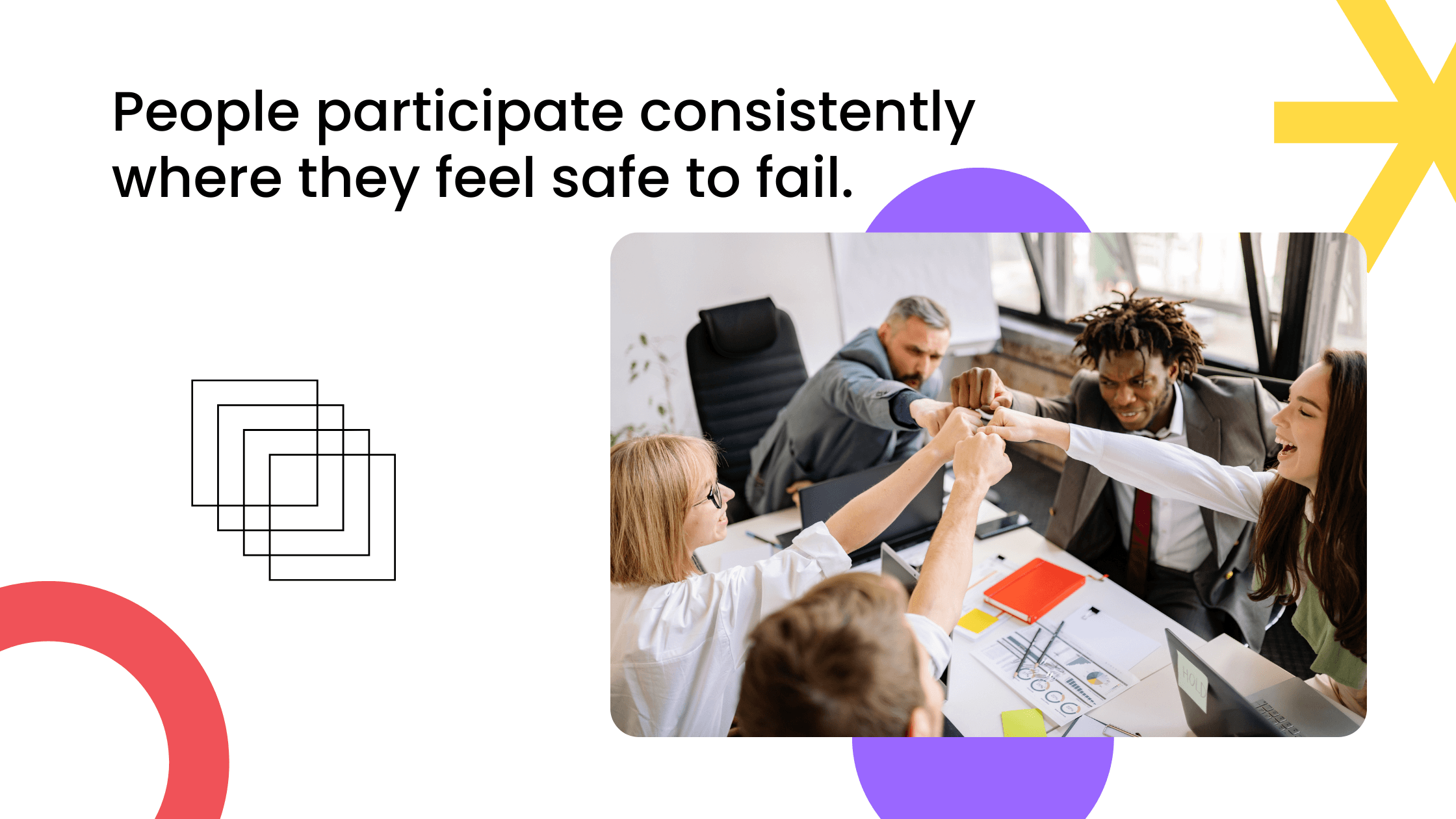
Most articles about building psychological safety in communities focus on workplaces and teams. The principles are sound, but they fall short when applied directly to coaching communities.
In a coaching context, psychological safety isn’t about performance reviews or speaking up in meetings. It’s about whether members feel comfortable showing up imperfectly.
When safety is high, consistency feels easy. When safety is low, disengagement feels inevitable.
This is one of the most overlooked drivers of sense of belonging in coaching programs, and one of the strongest predictors of long-term retention.
What Safety Looks Like in Real Coaching Communities
In practice, psychological safety in a coaching community shows up in small, repeatable moments.
Members feel safe when they know:
how participation is expected to look
what happens if they fall behind
how others will respond to questions or updates
Safety is less about encouragement and more about predictability.
When members can anticipate the tone, response, and rhythm of the community, participation stops feeling risky. Showing up becomes routine instead of emotionally taxing.
This is why communities with high safety don’t need constant prompting. Members already know what’s expected, and that they won’t be judged for trying.
Why Fear of Judgment Kills Participation
Fear is a powerful disengagement driver. In coaching communities, fear usually isn’t loud. It shows up quietly as:
not posting updates
skipping sessions
“catching up later” that never happens
The most common fear isn’t failure. It’s being seen as behind, unprepared, or not good enough.
When members feel exposed without support, they choose silence over participation. Over time, silence turns into drop-off, directly impacting coaching community retention.
Psychological safety reduces this fear by normalizing progress at all stages, not just success.
Simple Safety Signals Coaches Often Miss
Many coaches assume safety exists because no one is complaining. That’s rarely true. Safety is communicated through signals, not statements.
Members look for cues such as:
how missed participation is acknowledged
whether imperfect progress is accepted
how consistently norms are reinforced
When these signals are unclear or inconsistent, members hesitate. When they’re clear and steady, participation increases without added effort.
This is how building psychological safety in communities directly supports consistency: it removes the emotional cost of showing up.
Why Safety Leads to Belonging, and Belonging Leads to Retention
A strong sense of belonging in coaching programs doesn’t come from motivation or inspiration. It comes from repeated experiences of being accepted while learning.
When members feel safe, they participate more. When they participate more, they feel seen. When they feel seen, they stay.
Psychological safety isn’t a soft concept, it’s a structural requirement for sustainable engagement.
The next section explains how accountability systems can reinforce this safety instead of undermining it.

Accountability Systems That Don’t Require Constant Reminders
When coaches look for client accountability in coaching, most advice points to more check-ins, follow-ups, or tighter goal tracking. That approach doesn’t scale, and it rarely solves consistency.
In coaching communities, accountability works best when it’s embedded into the environment, not enforced by the coach.
This is how high-retention communities keep coaching clients consistent without constant reminders.
Peer Accountability vs Coach Accountability
Coach-led accountability puts the coach at the center of every action:
the reminder comes from the coach
progress is reported to the coach
accountability depends on the coach’s attention
Over time, this creates dependency and fatigue, for both sides. Peer accountability works differently. When progress is shared within the community, consistency becomes social rather than hierarchical. Members are no longer showing up for the coach; they’re showing up with others.
This shift reduces pressure, increases belonging, and strengthens long-term engagement.
Why Visibility Beats Private Goal Tracking
Private goal tracking hides effort. In many coaching programs, clients track progress privately and report back occasionally. When momentum drops, no one notices until disengagement has already set in.
Visible progress changes behavior. When members can see others making small, honest updates, accountability becomes ambient. Participation feels normal, not performative. Even low-effort actions feel worthwhile because they’re acknowledged.
This is why shared progress is one of the strongest drivers of client accountability in coaching communities. It reinforces effort without adding pressure.
Small Wins > Big Commitments
Large commitments create friction.
When accountability is framed around major outcomes, members who fall behind often disengage entirely. Missing one milestone feels like failure.
Small wins lower the emotional cost of participation.
When communities reinforce frequent, achievable actions, consistency becomes easier to maintain. Members stay engaged because progress feels attainable, even during busy or difficult weeks.
This is one of the most effective ways to keep coaching clients consistent over time: design accountability around momentum, not perfection.
Accountability That Supports Retention
Accountability systems work when they:
reduce reliance on willpower
distribute responsibility across the community
normalize progress at every stage
When accountability feels supportive instead of corrective, participation increases, and retention follows.
The next section explores how community structures like pods, events, identity cues, and rituals reinforce these accountability systems at scale.
Community Structures That Strengthen Trust & Accountability
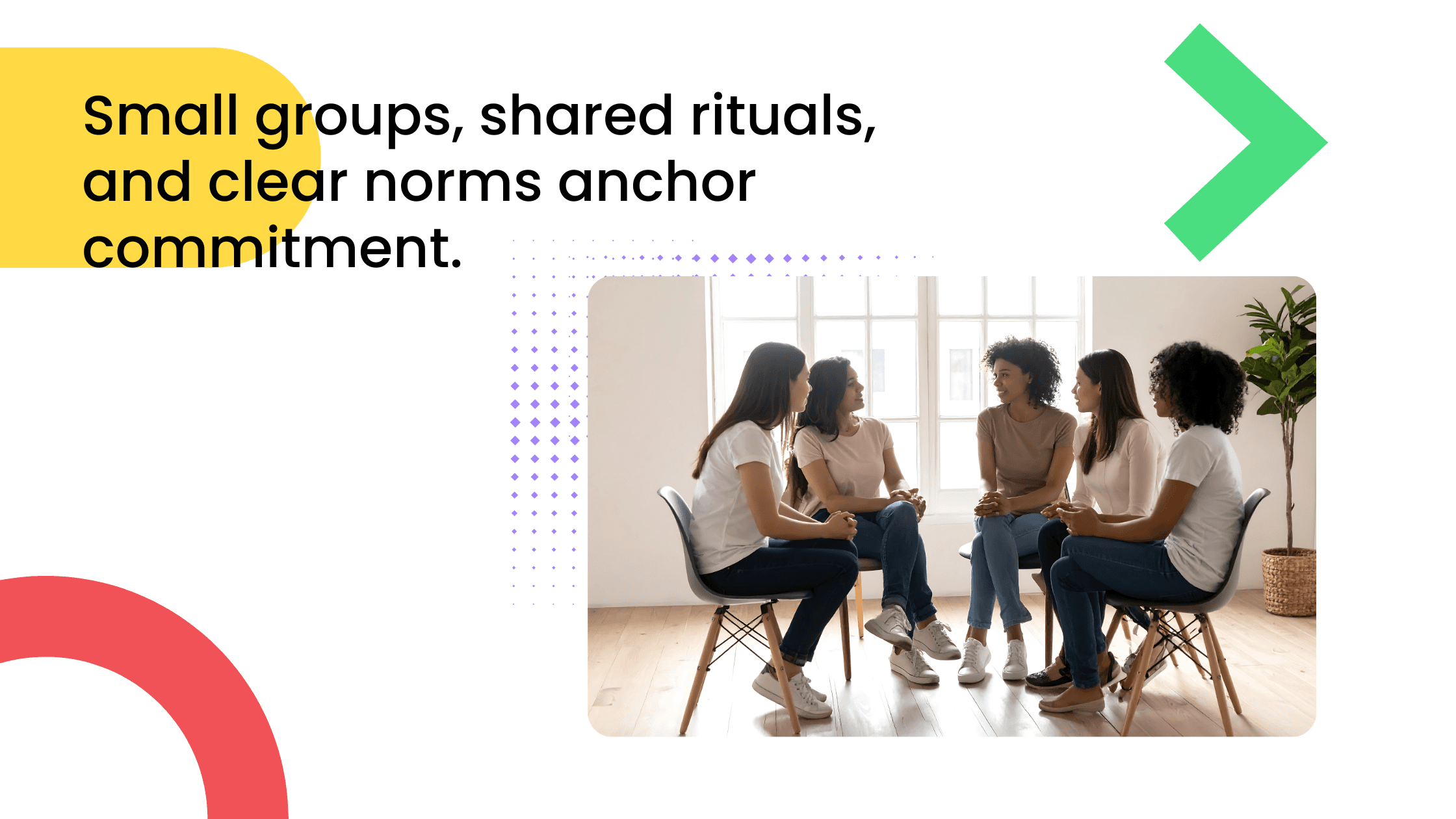
Trust and accountability don’t emerge from intention alone. In high-retention coaching communities, they’re reinforced through specific structures that shape how members interact week after week.
These structures don’t replace good coaching. They support it, by making participation predictable, visible, and socially reinforced.
Below are the four most effective structures used in coaching communities that consistently retain members.
Accountability Pods and Small Peer Groups
Small peer groups create a safe space for visibility.
When members are placed in consistent, small groups, accountability becomes relational rather than performative. Progress is shared with people who recognize patterns, effort, and context, not with a faceless crowd.
This reduces pressure, increases follow-through, and makes consistency feel manageable. A clear framework on how to run accountability pods in a coaching community ensures these groups are structured intentionally, with defined rhythms, roles, and check-ins that turn peer support into measurable progress.
Live Events as Trust Accelerators
Live events do more than deliver content.
They create shared moments where tone, vulnerability, and effort are experienced in real time. These moments build trust faster than asynchronous interaction alone.
In coaching communities, regular events reinforce rhythm and familiarity, lowering friction around participation between sessions. A thoughtful understanding of how events improve relationships in a coaching community makes it clear that consistent, well-designed gatherings strengthen emotional connection, deepen trust, and accelerate long-term engagement.
Shared Identity and Language Inside the Community
Communities retain members when they feel distinct.
Shared language, values, and reference points help members see themselves as part of something larger than a program. This identity reduces churn because participation feels meaningful rather than transactional.
When identity is clear, accountability becomes cultural, not enforced. Understanding how shared identity creates belonging in coaching communities clarifies why identity-driven design strengthens engagement, deepens commitment, and turns participation into a natural expression of who members believe they are.
Consistent Rituals That Anchor Behavior
Simple, repeatable actions done at the same time, in the same way, remove decision fatigue. Members don’t ask whether to show up; they already know when and how.
These rituals quietly sustain momentum, even during low-energy weeks. This is precisely why consistent rituals keep clients accountable: they reduce friction, normalize participation, and make progress the default rather than the exception.
Why Structure Matters for Retention
These structures work because they:
reduce uncertainty
normalize participation
distribute accountability across the community members
They create an environment where trust and accountability reinforce each other, without relying on constant reminders.
The next section looks at why engagement still breaks down when these structures are missing, and what to fix first.
7 Reasons Engagement Breaks in Coaching Communities (And What to Fix First)

When coaches ask why clients stop showing up, they often assume the answer is effort or commitment.
In reality, disengagement in coaching communities is usually caused by structural friction. When participation feels confusing, risky, or unrewarding, people quietly withdraw, no matter how valuable the coaching is.
Below are the most common reasons engagement breaks down, and why each one directly impacts coaching community retention.
No Social Visibility
When progress is invisible, effort feels pointless.
In many coaching communities, members work in isolation. They don’t see others showing up, sharing, or moving forward. Without visibility, participation lacks reinforcement.
Over time, this erodes momentum. If no one can see progress, there’s little reason to contribute.
Unclear Norms
People disengage when they don’t know how to participate “correctly.”
Unclear norms, about posting, sharing, or asking questions, create hesitation. Members worry about saying the wrong thing or overstepping.
Silence follows uncertainty. And silence is one of the fastest paths to disengagement.
Overcrowded Spaces
Large, unstructured spaces dilute attention.
When too many conversations compete for focus, members feel lost. Their contributions disappear quickly, reducing the sense that participation matters.
Overcrowding doesn’t create energy. It creates noise, and noise pushes people out.
No Weekly Rhythm
Consistency requires predictability.
Without a clear weekly rhythm, participation depends on memory and motivation. Members aren’t sure when to check in, share progress, or engage.
When rhythm is missing, engagement becomes optional, and optionality quickly becomes forgettable.
Coach-Centric Accountability
When accountability flows only through the coach, engagement bottlenecks.
Members wait for prompts, feedback, or approval instead of supporting each other. This creates dependency and limits scale.
As the coach’s attention stretches thin, participation drops, and coaching community retention declines.
Fear of Falling Behind
Falling behind feels like failure when progress is framed narrowly.
In communities that highlight only wins or milestones, members who struggle feel exposed. Instead of re-engaging, they disappear.
This fear is one of the most common, but least visible, reasons clients stop showing up.
Lack of Identity Reinforcement
When a community lacks a shared identity, participation feels transactional.
Members see themselves as consumers of content, not part of a collective journey. Without identity reinforcement, there’s no emotional reason to stay.
Communities that don’t reinforce “who we are” lose members even when results are delivered.
Why These Issues Compound Over Time
None of these problems look dramatic in isolation. Together, they create an environment where disengagement feels safer than participation.
This is why many coaches experience steady drop-off rather than sudden churn.
The next step is understanding how to design systems that prevent these failures before they happen, and how to fix them when they already exist.
How to Design Trust & Accountability Into Your Coaching Community (Practical Checklist)
Once you understand the psychology behind coaching community retention, the next step is design.
You don’t ask members to trust the community. You don’t demand accountability.
You design the environment so trust and accountability emerge on their own.
This checklist shows how to build trust with coaching clients and reinforce accountability in coaching programs by designing systems that support consistency over time.
What to Design in Week 1
Week one sets expectations. If trust and accountability are unclear here, fixing engagement later becomes much harder.
At this stage, members should clearly understand how participation works, what “showing up” looks like, and how progress is shared. Ambiguity in the first week creates hesitation that lingers.
Design early experiences that feel safe and achievable. Early participation should require low effort but provide visible reinforcement. This signals that the community values progress, not perfection.
When week one is predictable and welcoming, trust forms quickly, and retention starts early.
What to Reinforce Weekly
Trust is built through repetition, not explanation.
Weekly reinforcement keeps accountability from feeling optional. When rhythms are consistent, members don’t rely on memory or motivation to participate. They already know when and how to engage.
At this stage, the goal isn’t intensity. It’s reliability.
Weekly actions should make progress visible, normalize participation at all levels, and reinforce the shared identity of the community. When this happens, accountability in coaching programs becomes distributed across the group instead of resting on the coach.
Consistency comes from knowing what happens every week, and seeing others participate alongside you.
What to Review Monthly
Monthly reviews prevent slow disengagement.
Over time, participation patterns change. What felt clear in the beginning can become noisy or uneven. Monthly reflection allows you to adjust structure without disrupting trust.
This is the moment to notice where visibility is dropping, where norms are slipping, and where members may feel left behind. Small corrections here protect long-term coaching community retention.
Strong communities don’t rely on constant intervention. They rely on periodic calibration.
Why This Checklist Works
This approach works because it treats trust and accountability as design outcomes, not personality traits.
When the environment is predictable, fair, and socially reinforcing, consistency becomes the default. Members don’t need to be pushed, they stay because participation feels safe and meaningful.
The final section ties everything together and explains why most coaching communities lose engagement over time when these systems are missing.
Why Most Coaching Communities Lose Engagement Over Time
Most coaching communities don’t fail because the coaching isn’t good.
They lose engagement because the systems that support trust and accountability slowly erode. Participation becomes optional, visibility drops, and consistency starts to depend on motivation instead of structure.
This decline is gradual, which is why many coaches don’t notice it until retention is already affected.
Over time, many of these issues become harder to fix when coaches rely on rented platforms that limit structure, visibility, and control. This is why many coaches eventually realize they need a branded online coaching community that’s designed around their own systems, not someone else’s defaults.
Tools Don’t Create Trust, Systems Do
It’s easy to assume that better tools will fix engagement. More features, more channels, more integrations - well, none of these create trust on their own.
Trust forms when members experience:
predictable interactions
consistent norms
fair visibility
reliable follow-through
Without systems that reinforce these behaviors, even the best tools become passive containers. Members log in less, contribute less, and eventually disengage.
Communities that retain members focus less on what tools they use and more on how participation is designed.
Why Community Design Matters More Than Content
High-quality content attracts attention. Good community design sustains participation.
Many coaching communities continue adding content while engagement drops. The assumption is that more value will bring people back. In practice, content alone doesn’t solve disengagement.
What keeps people involved is not access to information, but the feeling that:
showing up matters
progress is seen
participation is expected and supported
When design is weak, even great content is consumed quietly, or not at all.
This is why long-term coaching community retention depends on structure, rhythm, and shared accountability more than volume of content.
The Pattern Behind Sustainable Engagement
Communities that maintain engagement over time are not louder or more complex. They’re clearer.
They make participation easy to understand, safe to attempt, and socially reinforced. When that environment exists, members stay consistent without being chased.
That’s the difference between communities that slowly fade and those that continue to grow quietly stronger.
The final takeaway brings all of this together, and clarifies what consistency really depends on.
FAQs About Coaching Accountability
What Is Accountability in Coaching?
Accountability in coaching is not about pressure or constant follow-ups. It’s about creating conditions where progress is visible, expectations are clear, and effort is socially reinforced.
In coaching communities, accountability works best when it’s shared, supported by peers and systems, rather than enforced only by the coach. This makes consistency feel normal instead of forced.
How Do You Build Trust in a Coaching Community?
Trust in a coaching community is built through predictability and fairness.
Members trust a community when they know how participation works, how others will respond, and what happens if they fall behind. Clear norms, consistent rhythms, and reliable follow-through create safety, which allows trust to form over time.
Trust isn’t created through motivation but design with intent.
Why Do Coaching Clients Stop Engaging?
Most coaching clients stop engaging because participation feels unclear, risky, or emotionally costly.
Fear of judgment, lack of visibility, unclear expectations, or absence of shared rhythm all contribute to disengagement. When showing up feels uncomfortable or pointless, clients protect themselves by pulling away.
Disengagement is usually a signal that the environment needs adjustment, not that the client lacks commitment.
How Do Coaching Communities Improve Retention?
Coaching communities improve retention by reducing reliance on motivation and increasing structural support.
When trust, psychological safety, shared identity, and accountability loops are designed into the community, consistency becomes easier to maintain. Members stay because participation feels safe, meaningful, and socially reinforced, not because they’re reminded to stay.
This is the foundation of long-term coaching community retention.
Final Takeaway: Consistency Is a Feeling, Not a Trait
Coaches often assume consistency is something clients either have or don’t.
In reality, consistency is a response to environment.
When a coaching community feels safe, predictable, and supportive, showing up doesn’t require willpower. It feels natural. When it doesn’t, even motivated clients disengage.
If you’re building a coaching community, the question isn’t how often you remind clients. It’s what systems you’ve built to make showing up feel safe and expected.
When trust and accountability are designed into the community, and supported by a branded online coaching community you control, retention stops being a struggle and becomes a byproduct.
Ready to Design a Community That Retains?
If you want to build a coaching community where trust, accountability, and consistency are built into the system, not managed manually, you can explore how Wylo helps coaches design communities that retain members naturally.
Start a free trial and see how strong community design changes engagement.

Omnath
Founder of Wylo, a highly comprehensive and customizable community platform for coaches, brands, and creators. Omnath helps coaches build structured, scalable, community-driven businesses through simple systems, clear frameworks, and high-quality client experiences.